

Cover photo: Nandu Chitnis, ONGC Bombay High South Field, via Wikimedia Commons (CC BY 2.0).
In 2025-26, India’s refineries processed about 272 million tonnes of crude. Indian oilfields gave about 28 million tonnes. Tankers brought in 246.6 million tonnes. Ask any aspirant why, and you will hear “we don’t have oil”. That answer is only half true, and the other half is the part UPSC asks about.
What all is covered in this blog
Numbers make headlines. The reasons behind them make answers. This blog walks through the oil story from an aspirant’s seat: how big the gap is, why ageing fields keep slipping, why finding new oil takes a decade, what the government is changing, and why even a revival will not end imports.
The gap: production versus imports, and the 88.7 per cent number
Ageing fields: why a mature oilfield loses output every year
The lost decade: licensing rounds, subsidies and why today’s output reflects yesterday’s decisions
The reset: HELP, OALP, “No-Go” areas and the Samudra Manthan deepwater mission
The honest limit: why pumping more is only one part of energy security
Prelims facts and Mains questions
GS angles: GS1 (geography, sedimentary basins), GS2 (government policy), GS3 (economy, energy security, infrastructure), plus Prelims.
1. The gap, in one picture
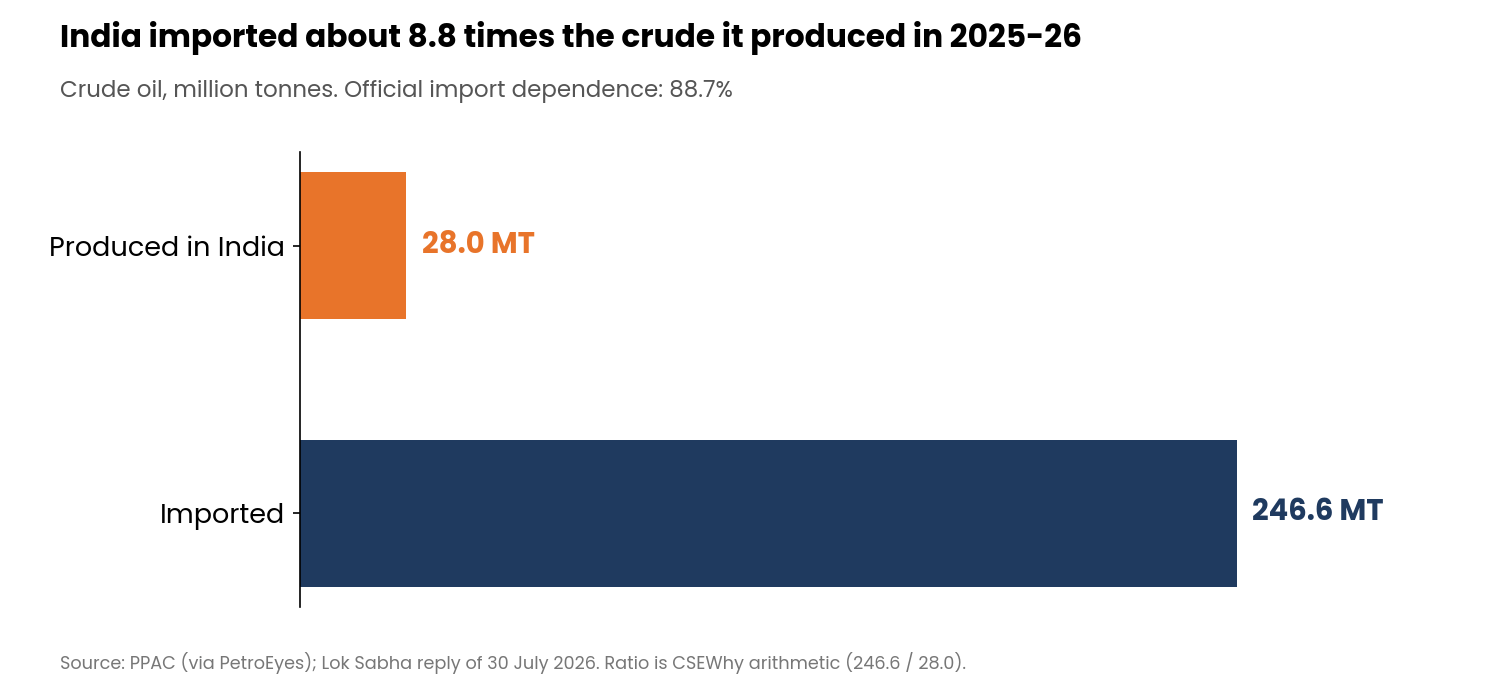
India imported 246.6 million tonnes of crude oil in 2025-26 (about 4.95 million barrels a day) and produced 28.0 million tonnes at home (about 0.56 million barrels a day). The Petroleum Planning and Analysis Cell (PPAC) puts import dependence for crude at 88.7 per cent.
The government told Parliament that import dependence rose from 85.5 per cent in 2021-22 to 88.7 per cent in 2025-26 (provisional), while domestic crude output slipped from 29.7 to 28.0 million tonnes over the same years. The Times of India, citing ministry data, reports, in an article of 23 April 2026, that crude output fell for the eleventh year in a row in 2025-26, and is down about 22 per cent since 2014-15.
India imported about 8.8 times the crude it produced in 2025-26. The refineries are not the problem. India’s installed refining capacity is about 267 million tonnes a year, and it even exported about 61.5 million tonnes of petroleum products in 2025-26. The weak link is the crude going in.
The Times of India adds a recent reason this matters: the US-Iran conflict made supplies harder to source, and refiners paid higher prices for cargoes and still faced shortages in March, as the paper reports.
2. Ageing fields: the treadmill
Most of India’s oil still comes from mature fields, many of them decades old. An oilfield is like a bottle of fizzy drink: as it empties, the pressure falls, and the oil comes out slower.
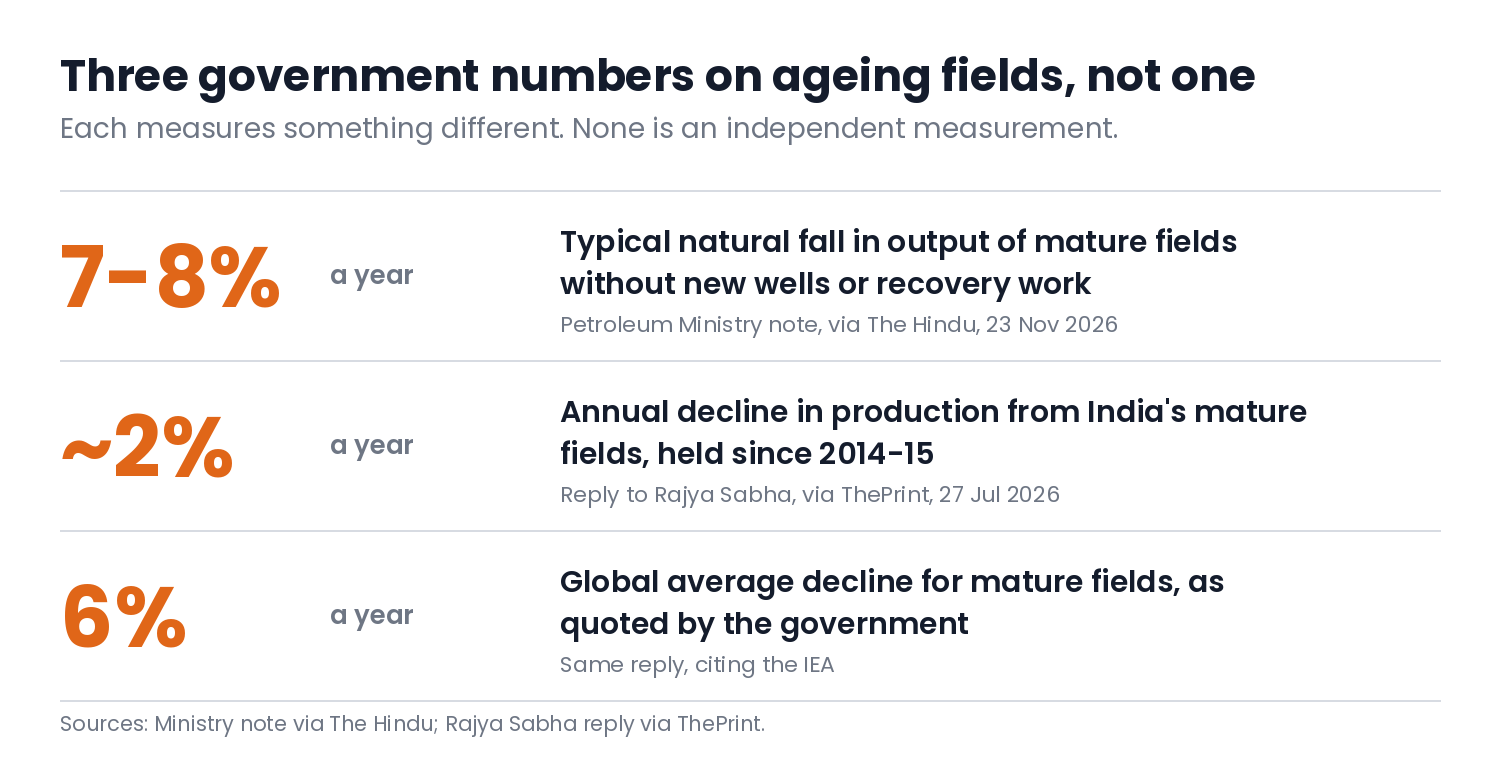
Two government statements put numbers on this. The Petroleum Ministry’s note, reported by The Hindu on 23 November 2026, says mature fields generally lose 7 to 8 per cent of their output every year without intervention. Separately, in a written reply to the Rajya Sabha, reported by ThePrint on 27 July 2026, the government said the decline in its mature fields has been about 2 per cent since 2014-15, against about 6 per cent globally (citing the IEA). The two numbers measure different things and the reports do not reconcile them, so quote each as a government statement, not as an independent measurement.
Why do old wells struggle? The reply lists rising water production, sand ingress, limited reservoir pressure and complex subsurface geology.
The Hindu reports the ministry saying the steepest fall has come from private producers, whose mature fields saw double-digit declines over the past year.
The takeaway: holding the line on old fields is already an achievement. But a treadmill only keeps you in place. To grow, you need new oil.
3. The lost decade: why 2026 is paying for 2010
New oil comes from exploration, and exploration is slow. The ministry’s note says it takes five to ten years to go from awarding a block to first production. So “output in 2026 is the result of what was, and was not, done a decade ago.”
Two things went wrong in that earlier period, according to the note:
A licensing gap. After the ninth round of the New Exploration Licensing Policy (NELP) was launched in 2010, no new exploration round was offered until 2016. Fields producing then were not replaced by new ones.
A subsidy burden. Until 2015, ONGC and Oil India were made to fund a large share of the subsidy on diesel, LPG and kerosene through discounts on the crude they sold to oil marketing companies. The note says ONGC paid Rs 49,421 crore towards this in 2012-13 against a profit of Rs 20,926 crore, and Rs 56,384 crore in 2013-14 against a profit of Rs 22,095 crore. That burden ended from 2015-16.
The decisions of one decade decide the output of the next. That is the ministry’s own line, and it is a good one for an Essay or a Mains intro.
Also note a criticism. The Times of India, citing an Economic Times report, says that despite reforms, global oil majors have shown limited participation, and most licensing rounds of the past decade were dominated by domestic public sector firms.
4. The reset: what the government has changed
Since 2014 the government has built a string of policies. The Lok Sabha reply of 30 July 2026 lists them. The ones worth remembering:
HELP (Hydrocarbon Exploration and Licensing Policy), 2016: one licence for all hydrocarbons (oil, gas, CBM, shale), open acreage, a revenue-sharing model in place of production sharing, and marketing and pricing freedom (PM India, Cabinet decision of 10 March 2016).
OALP (Open Acreage Licensing Policy): companies study the National Data Repository, carve out blocks of their choice and submit an Expression of Interest at any time, instead of waiting for a government-designed round (Ministry of Petroleum and Natural Gas). In Rounds I to IX, 172 blocks covering 3.79 lakh sq km were awarded, with committed investment of about USD 4.36 billion, 114 exploratory wells drilled and 21 discoveries (as on 31 March 2026).
“No-Go” areas, 2022: about 1 million sq km of offshore area, blocked for exploration for decades, was released.
Oilfields (Regulation and Development) Amendment Act, 2025, and the Petroleum and Natural Gas Rules, 2025: contractual stability and faster dispute resolution.
Hydrocarbon Resource Assessment Study (HRAS 2025), launched on 17 July 2025, to assess resources across all sedimentary basins.
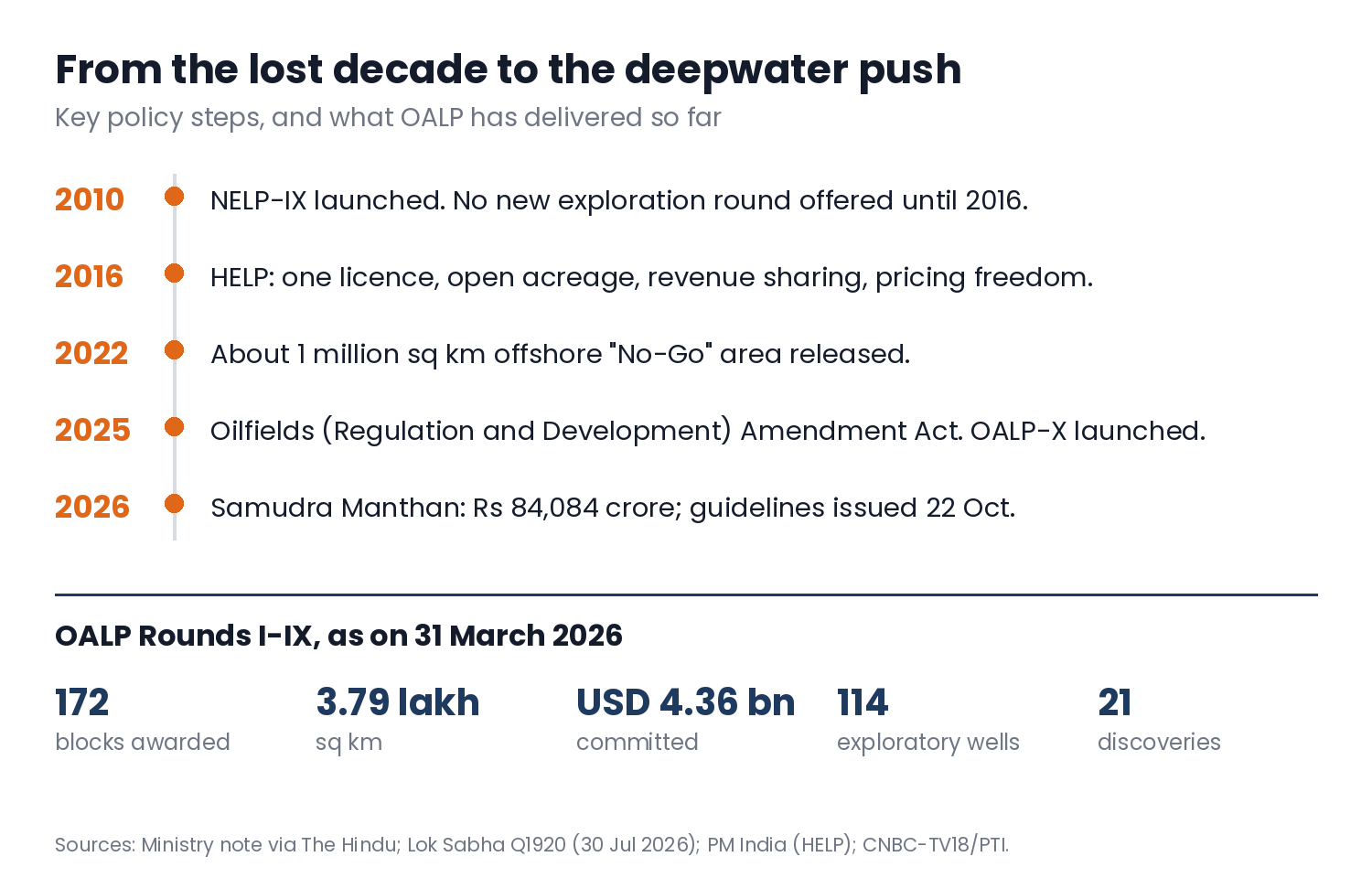
Now the deepwater push. The ministry’s note says lasting growth has to come from deepwater exploration, where discovery to production takes the longest. The National Deepwater Exploration Mission under Samudra Manthan has committed Rs 84,084 crore in its first phase to seismic surveys, more than 60 deepwater wells and shared offshore infrastructure, with the government bearing up to half the cost of a deepwater well, per The Hindu. The scheme’s operating guidelines were issued on 22 October 2026, with support of up to 50 per cent of eligible deepwater drilling cost, capped at Rs 675 crore per well, PTI reported via CNBC-TV18 on 9 November 2026. The same report says OALP Round X (launched February 2025) offered 25 blocks over about 1.83 lakh sq km, with 12 ultra-deepwater blocks, and that the deadline for deepwater and ultra-deepwater bids has been extended, for the seventh time, to 10 December 2026. Investors are still hesitating.
What does the ministry promise? It expects production to pick up in four to five years (the headline’s wording; the note’s text also mentions three to four years for some measures). That is a projection from the ministry’s own note, not a result yet. In your answers, write “the government expects”, never “production will”.
One more data point to stay balanced. The Hindu notes that the Index of Core Industries shows crude oil and natural gas have contracted for 22 and 28 months in a row respectively, as of the data the note cites. The turnaround has not begun yet.
5. The honest limit: pumping more is not the whole answer
Suppose every plan works. Suppose India adds a few million tonnes. India still refines about 272 million tonnes a year. A revival from 28 million tonnes is welcome, but it is a small number against that demand.
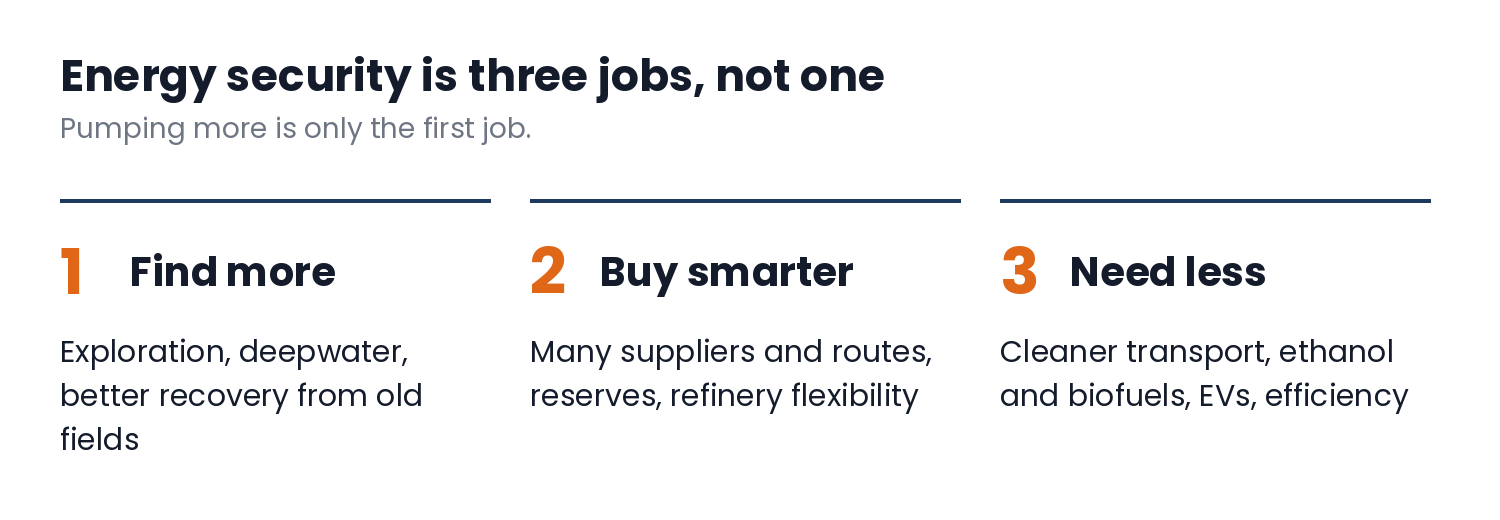
So a good answer to “Can India end its oil import dependence?” has two halves:
Supply side: new exploration, deepwater, better recovery from old fields, and a wider set of import suppliers so that one conflict does not choke the economy.
Demand side: cleaner transport, ethanol and biofuels, electric vehicles, gas and efficiency, which cut how much crude the country needs in the first place.
Cushions: strategic petroleum reserves and refinery flexibility to buy from different sources.
The best line for the conclusion: energy security is not about producing every barrel at home. It is about not being forced into a bad choice when the world shakes.
6. Prelims facts and Mains questions
Prelims box
Crude import dependence, 2025-26: 88.7 per cent (up from 85.5 per cent in 2021-22)
Crude: 28.0 million tonnes domestic, 246.6 million tonnes imported (2025-26)
Mature fields: ministry note says 7-8 per cent a year without intervention; govt says about about 2 per cent since 2014-15 (Rajya Sabha reply)
NELP (last round launched 2010) replaced by HELP (2016) and OALP
OALP Rounds I-IX: 172 blocks, 3.79 lakh sq km, 21 discoveries
“No-Go” area release (2022): about 1 million sq km offshore
Samudra Manthan (National Deepwater Exploration Mission): Rs 84,084 crore in phase 1
Know the bodies: PPAC, DGH, ONGC, Oil India
Mains practice
GS 3 | 150 words: “India’s oil import dependence is a result of past policy choices as much as geology.” Discuss.
GS 3 | 250 words: Examine the challenges of boosting domestic crude oil production in India. What policy measures have been taken to address them?
GS 3 / GS 2 | 250 words: Increasing domestic production alone cannot ensure energy security. Critically examine.
Answer frame: open with the gap (28 versus 246.6 million tonnes), explain the causes (ageing fields, the decade-long exploration gap, subsidy burden), outline the reset (HELP, OALP, No-Go release, deepwater mission), name the limits (long gestation, scale of demand, limited global participation), and close with a balanced way forward: explore, diversify, reduce demand.
Read the sources, then make your notes
ThePrint, 27 July 2026: India’s crude import dependence rises to record 88.7% as domestic output continues to decline (Rajya Sabha reply)
Lok Sabha Unstarred Question 1920, 30 July 2026: Exploration and Production of Hydrocarbons (Ministry of Petroleum and Natural Gas)
PetroEyes (reviewed 22 October 2026, citing PPAC data): India: An Import-Fed Refining System
PM India, 10 March 2016: Hydrocarbon Exploration and Licensing Policy (HELP)
Ministry of Petroleum and Natural Gas: Open Acreage Licensing Programme
CNBC-TV18 (PTI), 9 November 2026: OALP-X, XI deadline extended to December 10
One gap, one decade, one question that will keep returning: if you cannot pump every barrel at home, how do you make sure you never get caught short? For daily current affairs, high-value PDFs and notes, join the CSEWhy Telegram channel: telegram.me/csewhy