

What all is covered in this blog
An island most of us could not point to on a map is now the site of one of India’s biggest infrastructure bets - and one of its biggest environmental fights. This blog maps the whole story: what was cleared, what the Supreme Court just said, why the location matters more than the project, and how to use it in Prelims, Mains and Essay.
1. The news: what the Supreme Court said on October 5
On October 5, 2026, the Supreme Court refused the Union government’s request to stay proceedings in the Calcutta High Court against the Great Nicobar Island Development Project. The petition was filed by Meena Gupta, a former Union Environment Secretary - not a professional activist - who argues the project threatens a fragile ecosystem and violates the Forest Rights Act, 2006.
The bench, led by Chief Justice of India Surya Kant with Justice Joymalya Bagchi and Justice V. Mohana, made two observations worth underlining. One: ”preservation of culture is a constitutionally protected fundamental right.” Two, from Justice Bagchi: courts must filter what is genuinely the security of the state from what is commercial interest.
The Centre, through Attorney General R. Venkataramani, called the over Rs 72,000-crore project one of “immense” national and strategic importance, and argued there is ”no loss of habitation” for the island’s indigenous tribes.
For UPSC, the useful question is bigger than port vs environment: when the State calls a project “strategic”, who checks the trade-off - and on what evidence?
Read the order correctly. The Supreme Court has NOT stopped the project. It refused to pause the High Court case and asked the High Court to decide quickly. The project stands cleared; the legal challenge is alive.
2. What is actually being built
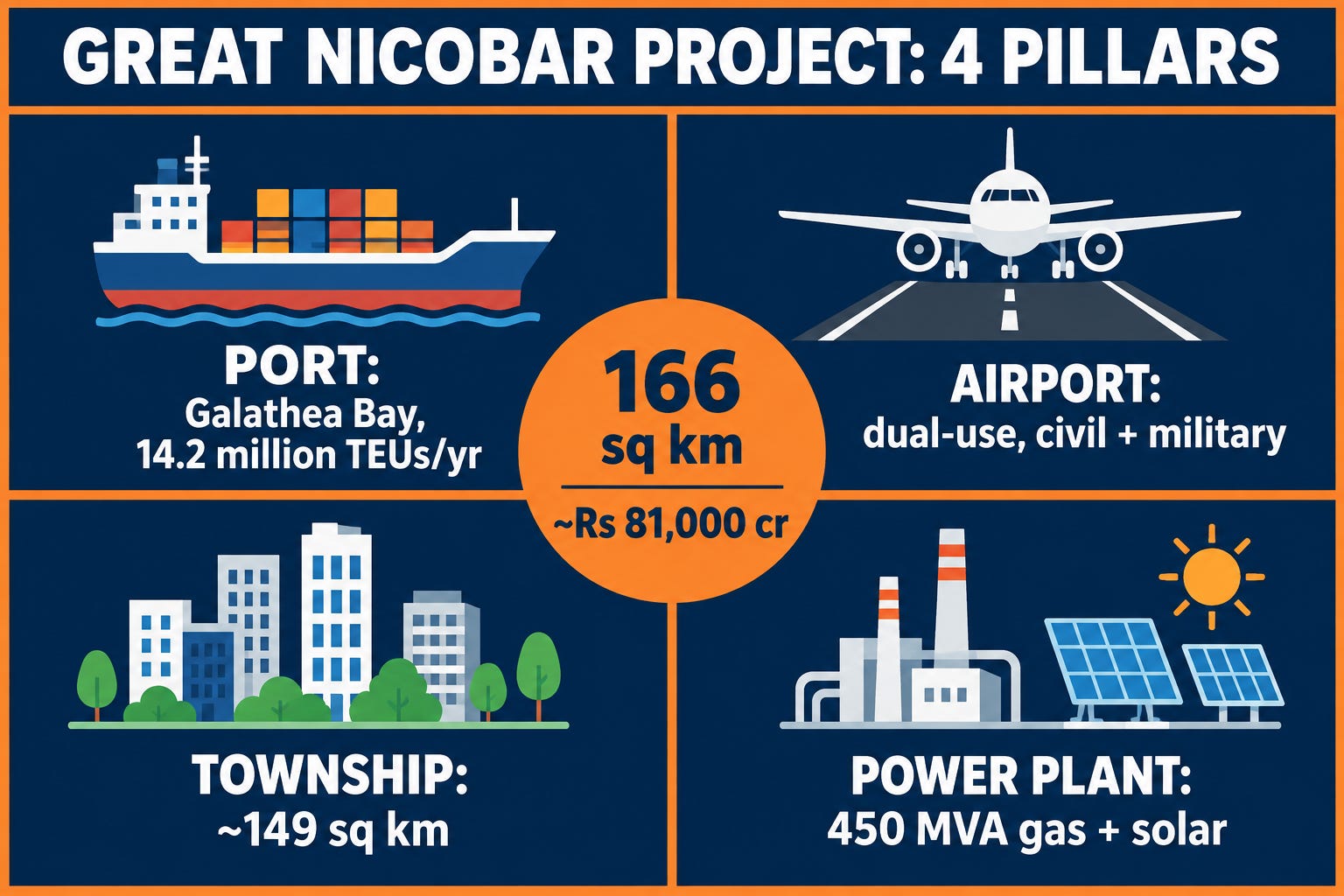
The project covers about 166 sq km on Great Nicobar, a 910 sq km island that holds Indira Point, India’s southernmost tip. Reported cost: around Rs 81,000 crore (the National Green Tribunal cleared it in February 2026, citing “strategic importance” and “adequate safeguards”).
It has four pillars:
A transshipment container port at Galathea Bay - projected to handle 14.2 million TEUs (20-foot containers) a year.
A dual-use international airport - civilian and military, the island’s second after the Navy’s airstrip at INS Baaz.
An integrated township - about 149 sq km of residential, commercial, tourist, logistics and defence facilities.
A 450 MVA gas-and-solar power plant.
Conceived by NITI Aayog; implemented by ANIIDCO (Andaman and Nicobar Islands Integrated Development Corporation).
3. Why this island: the Malacca logic
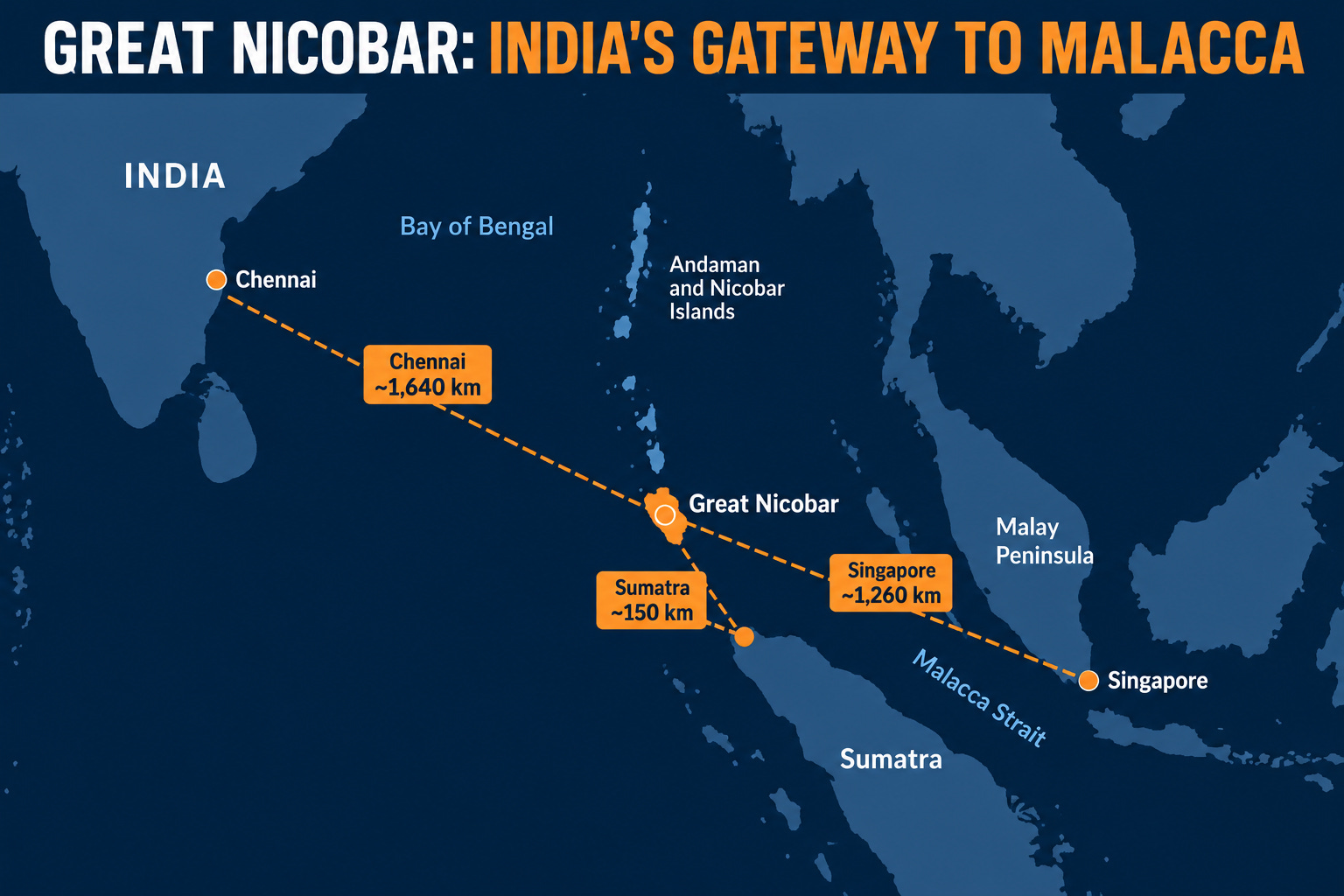
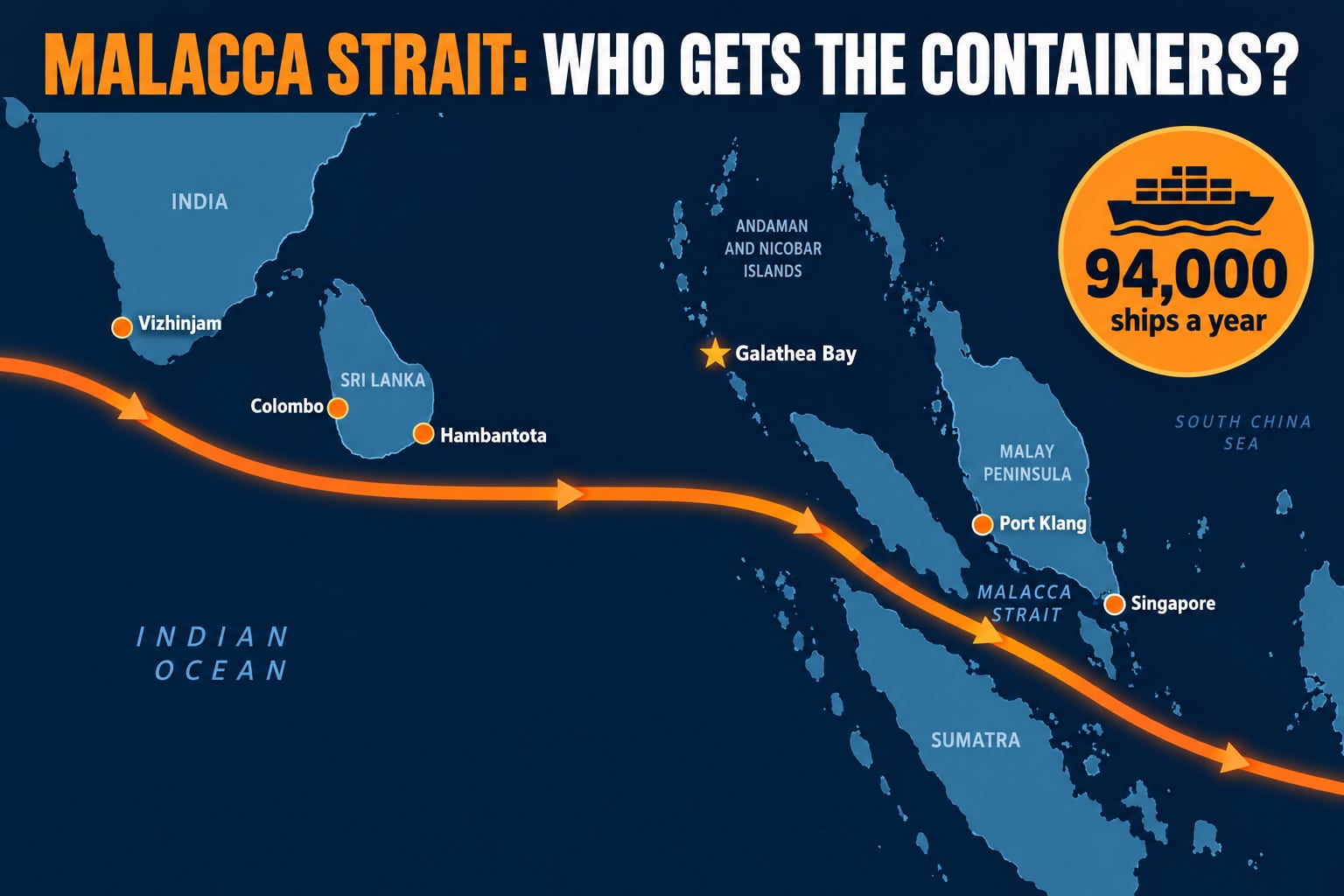
Geography is the entire argument. Great Nicobar is India’s closest territory to the Malacca Strait, the chokepoint between the Indian and Pacific Oceans. By World Economic Forum estimates, 94,000 ships pass through it every year, carrying roughly 30% of globally traded goods and a third of the world’s maritime oil trade.
Today India has exactly one operational transshipment port - Vizhinjam in Kerala, on the wrong coast for this traffic. Indian containers are currently shuttled through Colombo, Hambantota, Port Klang and Singapore. A port at Galathea Bay would compete for that pie.
The defence layer sits on top: the Andaman and Nicobar Command, India’s only tri-services command, has run from Port Blair since 2001. Project plans put defence infrastructure in the first construction phase.
The policy question is not “development or environment”. It is “who decides what a strategic project may cost, and who gets heard before the decision”.
4. The ecological bill
The build needs 130 sq km of forest diverted and almost one million trees felled. The Nicobars sit inside the Sundaland biodiversity hotspot, and almost the whole island is part of the Great Nicobar Biosphere Reserve.
Two sanctuaries - Galathea Bay and a megapode sanctuary - were denotified for the project. Galathea Bay is a nesting site of the leatherback sea turtle, and the project’s own environmental clearance admits the port will affect it. The Nicobar megapode, a ground-nesting bird found nowhere else on Earth, loses nesting mounds. As mitigation, the administration was asked to notify a leatherback sanctuary on Little Nicobar, a megapode sanctuary on Menchal Island and a coral sanctuary around Meroe Island.
The island’s population is projected to grow from 8,500 (2011 Census) to 6.5 lakh by 2050 - a 75-fold increase on an island that lost elevation in the 2004 tsunami.
5. The people: Shompen and Nicobarese
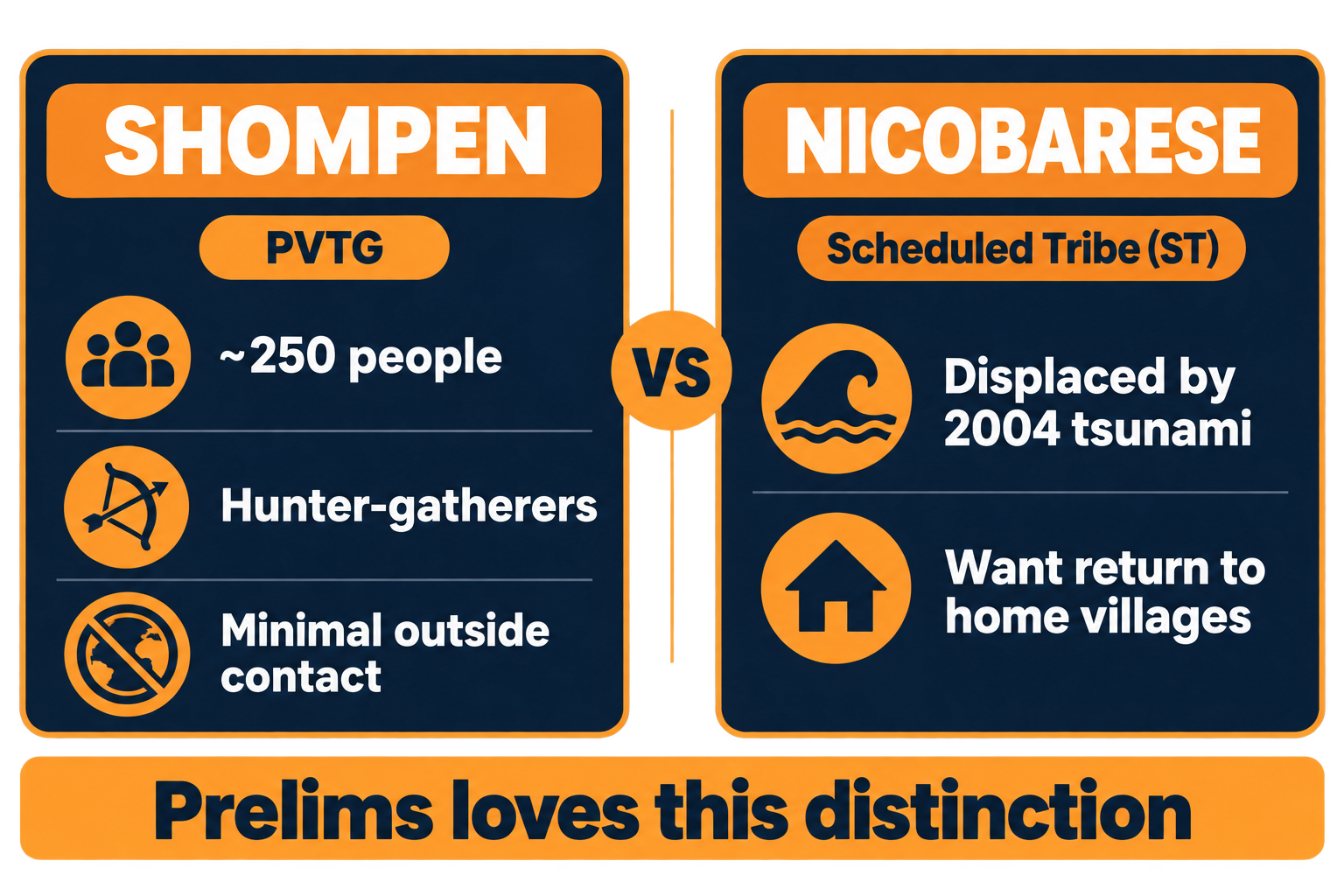
The Shompen are a Particularly Vulnerable Tribal Group (PVTG) - hunter-gatherers numbering around 250, with minimal contact with the outside world. Disease risk from contact is a documented fear. The Nicobarese, larger in number, lost villages in the 2004 tsunami; their long-pending demand is resettlement in their pre-tsunami villages, and their tribal council once revoked its no-objection certificate for a tribal-reserve denotification, saying the project’s scope was concealed from them.
This is exactly the ground the Forest Rights Act, 2006 was written for: forest-dwelling communities’ consent and rights before diversion of their forests. That is why the challenge runs through the Calcutta High Court - the Andaman and Nicobar Islands fall under its circuit jurisdiction - and why the Supreme Court’s line on culture as a fundamental right matters far beyond one island.
6. The UPSC lens
GS 1 (Geography): island geography, chokepoints, the 2004 tsunami’s reshaping of Indira Point.
GS 2 (Polity & Governance): Forest Rights Act, PVTG safeguards, Article 21 and the expanding meaning of culture as a fundamental right, judicial review of “strategic” projects.
GS 3 (Economy, Environment, Security): transshipment and the logistics economy, EIA process and denotification of protected areas, maritime security and the Andaman & Nicobar Command.
Essay/Ethics: growth vs ecology; whose consent counts.
7. Prelims facts - keep the distinctions clean
Indira Point, on Great Nicobar, is India’s southernmost point - it partly subsided in the 2004 tsunami.
Shompen = PVTG. The Nicobarese are a Scheduled Tribe but not a PVTG. Classic trap.
The Nicobars are in the Sundaland hotspot - not Indo-Burma, not the Western Ghats.
Vizhinjam (Kerala) is India’s first operational transshipment port; Galathea Bay is proposed, not operational.
Implementing agency is ANIIDCO, not NITI Aayog. NITI Aayog conceived the project.
The leatherback is a sea turtle; the megapode is a bird. Both lose nesting ground at Galathea Bay.
Prelims trap: “denotified” is not the same as “destroyed”. The Galathea Bay and megapode sanctuaries lost legal protection to clear the way - the replacement sanctuaries are on other islands (Little Nicobar, Menchal, Meroe).
8. Mains practice
GS 2 | 150 words: “Preservation of culture is a constitutionally protected fundamental right.” Discuss in the context of development projects affecting Particularly Vulnerable Tribal Groups.
GS 3 | 250 words: “Strategic infrastructure in ecologically fragile regions needs a higher burden of justification, not a lower one.” Examine with reference to the Great Nicobar Island project.
Answer frame: define the project and the strategic claim (Malacca, transshipment); lay out the ecological and tribal costs with numbers; weigh the EIA/NGT clearance against the pending High Court challenge; close with a way forward - independent monitoring, genuine FRA consent, phased build with review gates.
9. Read the sources, then make your notes
The Hindu, Oct 5, 2026: Supreme Court refuses to stay Calcutta HC order in Great Nicobar Island Project
Indian Express Explained, Feb 2026: As NGT clears Great Nicobar project - strategic importance and ecological fallout
Frontline (The Hindu), 2026: The Great Nicobar Project and the Erosion of Accountability
PIB: Great Nicobar Project FAQs
One island, one port, 250 people, and a question India will keep facing: what may a strategic project cost? For daily current affairs, high-value PDFs and notes, join the CSEWhy Telegram channel: telegram.me/csewhy