

Rank gets you into the IAS. It does not, on its own, get you your home state.
What all is covered in this blog
What an IAS cadre is and why it decides your whole career
Step 1: how vacancies are determined (1 Jan, 31 Jan, DoPT)
2026 change: 5 zones become 4 groups, with the group-wise list of states
Insider vs Outsider: home cadre vs any other cadre
Why rank matters, but is not the only factor (with the Uttar Pradesh example)
The 25-candidate cycle
The 6-step allocation process run by DoPT
The allocation formula in one view
Prelims facts, Mains angles and a quick revision list
“Getting your preferred IAS cadre isn’t simply about having a higher rank.”
Every year, thousands of aspirants dream of one thing: “Mujhe apna home cadre mil jaye.” But the cadre does not come from rank alone. From CSE 2026 onwards, the whole allocation system has changed - from 5 zones to 4 groups. Let’s walk through it, step by step, like a story.
1. What is an IAS Cadre?
A cadre is the State or Joint Cadre to which an IAS officer is allotted after the Civil Services Examination. Three simple questions explain it:
Who gets a cadre? IAS officers, after successfully completing the Civil Services Examination, are allotted a State or Joint Cadre.
What does it mean? Your cadre is the State/UT you serve in, holding various administrative positions throughout your career.
Why does it matter? It decides your place of posting, work environment, exposure to different issues, career growth opportunities and the kinds of roles you hold as an IAS officer.
In short: your rank gets you the service. Your cadre shapes the life you live in it.

2. Step 1: Vacancies are determined
Before a single candidate is allotted, the government fixes the number of vacancies for each cadre. It does this based on the cadre gap, state requirements and roster position. The sequence is short:
1 January - Cadre gap assessed. The gap is assessed as on 1 January of the year following the examination year.
31 January - State governments send requirements. States communicate their cadre-wise and category-wise vacancy requirements by 31 January.
DoPT determines vacancies. DoPT finalises cadre-wise and category-wise vacancies based on cadre gap, state requisitions and roster position.
Vacancies are determined for these categories: UR, SC, ST, OBC, Insider, Outsider.
Remember: the number of vacancies in each cadre and category varies every year, based on the cadre gap and the requirements received from States.
3. The big change: 2026, 5 Zones to 4 Groups
The cadre allocation system has been revised. The earlier 5-zone system (2017-2025) has been replaced with a 4-group system from CSE 2026 onwards.
Group I (5 cadres): AGMUT, Andhra Pradesh, Assam-Meghalaya, Bihar, Chhattisgarh
Group II (7 cadres): Gujarat, Haryana, Himachal Pradesh, Jharkhand, Karnataka, Kerala, Madhya Pradesh
Group III (8 cadres): Maharashtra, Manipur, Nagaland, Odisha, Punjab, Rajasthan, Sikkim, Tamil Nadu
Group IV (4 cadres): Telangana, Tripura, Uttarakhand, Uttar Pradesh, West Bengal
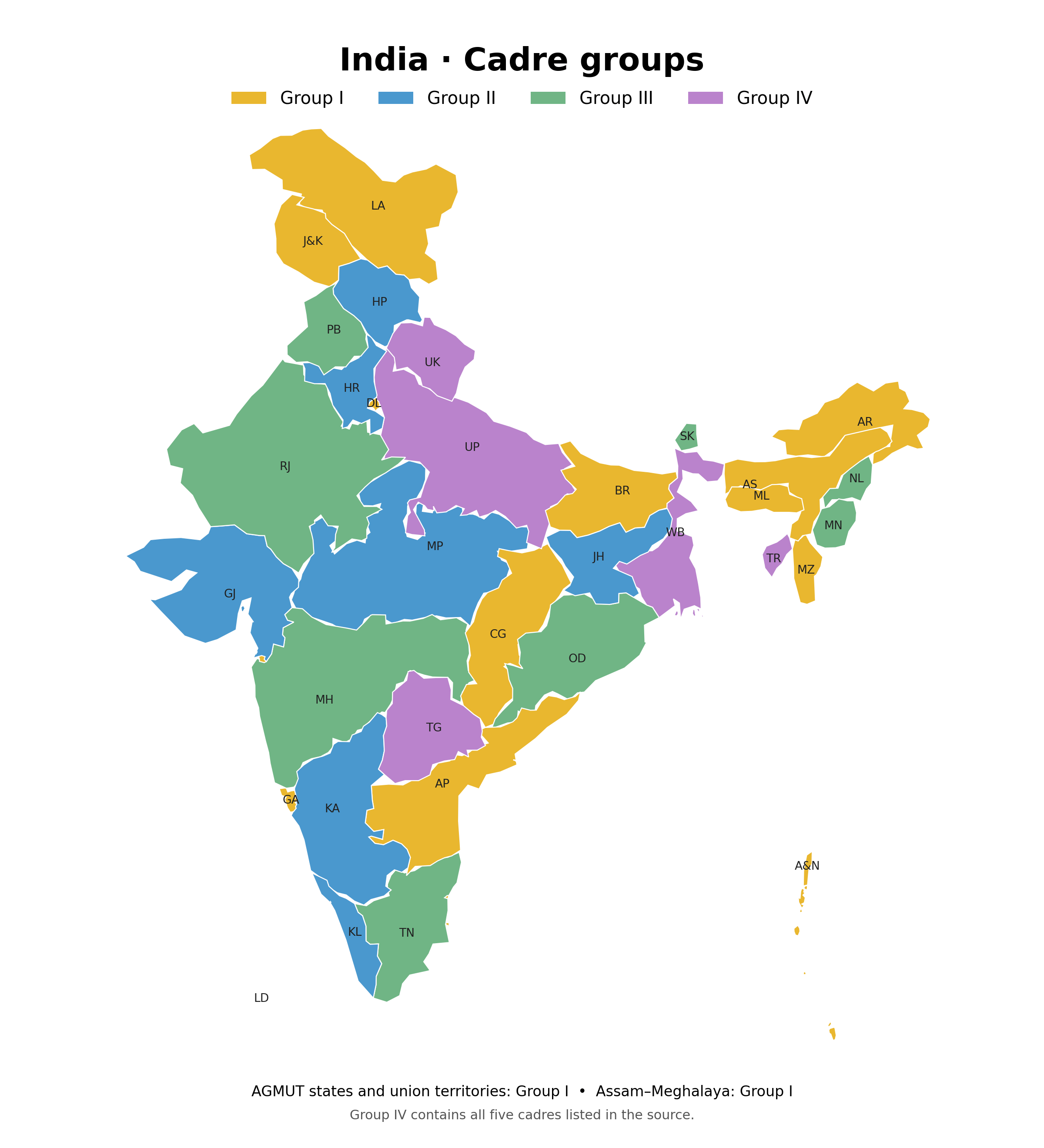
The revised cadre allocation policy was notified by DoPT on 23 January 2026 and is applicable from CSE 2026 onwards.
4. Insider vs Outsider
Candidates are first considered for their home cadre (insider). If not allotted there, they move to outsider allocation.
Insider = Home cadre. Your own State or home cadre. Example: a candidate from Uttar Pradesh, UP cadre = Insider.
Outsider = Other cadre. Any cadre other than your home cadre. Example: the same candidate, Rajasthan cadre = Outsider.
For insider allocation:
Subject to merit (within the relevant category)
Subject to availability of insider vacancies
You must give willingness for your home cadre
For outsider allocation:
Considered only after all eligible insiders are placed
Allocation is based on merit, category, vacancies, roster and the group cycle
Unfilled insider vacancies can later be converted into outsider vacancies as per policy
Key line: home cadre is considered only if the candidate gives willingness for it. Insider allocation is subject to merit, category and availability of insider vacancy.
5. Rank matters. But it is not the only factor.
For insider allocation, candidates are considered in order of merit (within their category) against the available insider vacancies. Insider allocation depends on three things:
Merit (within category)
Availability of insider vacancies
Willingness for your home cadre
A separate merit list is used for each category (UR/SC/ST/OBC) for insider allocation.
Example: insider vacancies, Uttar Pradesh. Assume there are 3 insider vacancies for the UR category in the UP cadre.
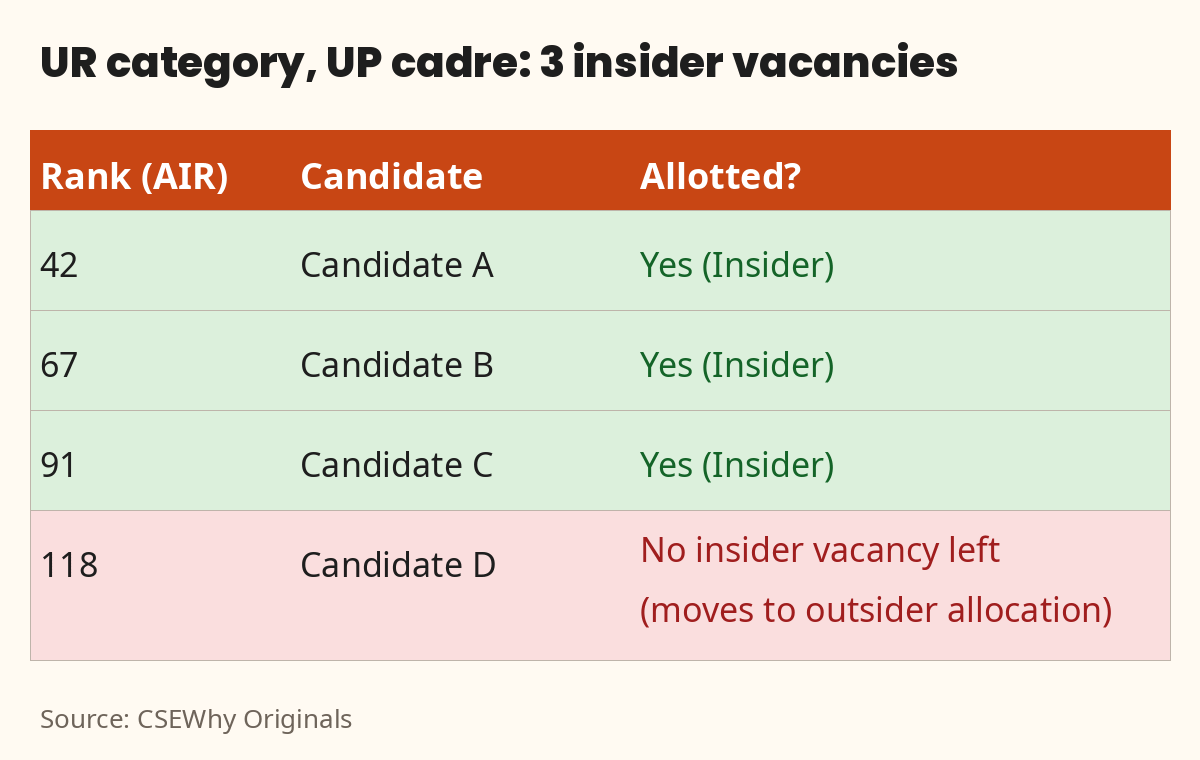
Candidate D missed out not because of a weak rank, but because the insider vacancies were already full. The next candidate moves to outsider allocation.
If a candidate is not allotted their home cadre due to non-availability of insider vacancies, they are considered in the outsider allocation round.
6. The 25-candidate cycle
There are 25 State/Joint Cadres for IAS. So the allocation process is structured in cycles of 25 candidates, as per the cadre allocation policy.
1st cycle: rank 1 to 25
2nd cycle: rank 26 to 50
3rd cycle: rank 51 to 75
4th cycle: rank 76 to 100 ... and so on
What happens in each cycle?
Candidates in the cycle are considered for insider allocation in their home cadres (as per merit, category and available vacancies).
Those not allotted their home cadre move to the outsider allocation process.
The cycle then continues for the next set of 25 candidates.
The 25-candidate cycle ensures that all State/Joint Cadres are represented in each round of allocation as per the prescribed roster.
7. How IAS cadre allocation actually happens (6 steps)
The allocation is done by DoPT as per the prescribed rules and a transparent, merit-based process.
Prepare rank list: UPSC prepares an overall merit list of candidates recommended for IAS (based on marks in Mains and Interview).
Form 25-candidate cycle: candidates are processed in cycles of 25 as per the cadre allocation policy.
Consider insider cadre: for each candidate, the home cadre given in the Detailed Application Form (DAF) is considered first, subject to merit, category and availability of vacancies.
Move to outsider (if not allotted home): if not allotted their home cadre due to non-availability of vacancies, they are considered for other cadres (outsider allocation).
Repeat for next candidate: the process continues sequentially for the next candidate in the merit list within the same 25-candidate cycle, and then the next cycle.
Final allocation list: DoPT prepares the final cadre allocation list, notified after completion of the entire process for all recommended candidates.
The entire process is governed by the IAS (Cadre) Rules, 1954 and the revised allocation policy notified by DoPT on 23 January 2026.
8. The allocation formula
An IAS officer is allotted a State/Joint Cadre based on multiple factors as per the prescribed rules:
Merit (within relevant category): candidates are considered in order of merit (AIR) within their category (UR/SC/ST/OBC/EWS).
Category (UR/SC/ST/OBC/EWS): a separate merit list is used for each category for cadre allocation.
Vacancies (cadre-wise and category-wise): the Government determines the number of vacancies for each cadre based on cadre gap, state requirements and roster position.
Insider / Outsider roster (as per prescribed roster): each vacancy is marked as insider or outsider as per the roster for that cadre and category.
Allocation cycle / group order (4-group system with rotating order): candidates are processed in cycles of 25 and allotted cadres in the prescribed group order (as per their rank and preferences).
Merit + Category + Vacancies + Roster + Group order, plus your preferences = Cadre allotted.
Rank alone does NOT decide your cadre. Cadre allocation for IAS is governed by the IAS (Cadre) Rules, 1954 and the revised policy notified by DoPT on 23 January 2026.
Quick revision: Prelims facts
Cadre allocation policy revised: 5 zones (2017-2025) to 4 groups (CSE 2026 onwards)
Policy notified by DoPT on 23 January 2026
Governing rules: IAS (Cadre) Rules, 1954
Number of State/Joint Cadres: 25, so allocation runs in cycles of 25
Group sizes: I = 5, II = 7, III = 8, IV = 4 cadres
Insider = home cadre (needs willingness); Outsider = any other cadre
Cadre gap assessed as on 1 January; states send requirements by 31 January
Mains angle (GS-2 / GS-4)
How does the cadre allocation policy balance merit, representation and the needs of States? Discuss the 2026 shift from zones to groups.
Does an insider/outsider roster strengthen federal balance in the All India Services?
Want more such explainers? Join the CSEWhy Telegram channel for notes, PDFs and daily updates: t.me/csewhy