

What all is covered in this blog
Yesterday the Supreme Court made a remark that every polity aspirant should note down: it has not approved any modified Form 6.
So I wanted one single post where SIR and Form 6 are covered from every UPSC angle. Here is the map:
The news hook: what happened in the Supreme Court on 5 October 2026 and why Form 6 is suddenly controversial
SIR and Form 6 basics: what they are, who files what (Forms 6, 7, 8)
Timeline: Bihar (2025), Phase II in 12 States/UTs, Assam, what is next
Polity: Article 324, 325, 326, RP Act 1950 (Sections 16, 19, 21), Registration of Electors Rules 1960, the 27 May 2026 judgment, ECI independence
History: franchise from 1909 to 1950, the first roll, earlier intensive revisions
Economy and development: migration, urbanisation, welfare targeting, cost of documents
Governance and ethics (GS 4): inclusion vs purity, burden of proof, the BLO on the ground
Prelims and Mains: quick facts, likely questions, answer-writing frame
One honest note: parts of this story are still being heard in court. I have used only what is reported by ECI, PIB and mainstream court reporting, and I have marked what is still pending.
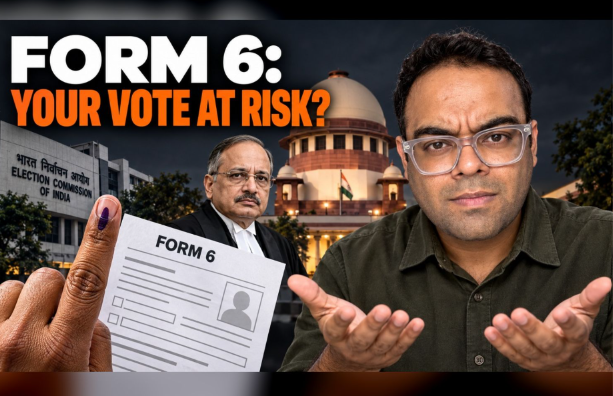
1. The news hook: what did the Court actually say?
A voter enrolment form sounds like the last thing you would want to read about. But this one takes us straight to a bigger question: who gets to decide the conditions for entering the electoral roll?
On 5 October 2026, CJI Surya Kant said the Supreme Court had not approved any modified Form 6. The Court said it would look at the ECI’s records to see who had changed what.
Why did that line matter? Because ECI’s 26 September statement had said the declaration attached to Form 6 for SIR had been upheld by the Court.
The Court was now saying: do not read our approval of SIR as approval of every change to this form.
The disputed online declaration asks about a link to the last SIR roll: your own name, a parent’s or grandparent’s name, or no such link. For someone enrolling for the first time, that is a very different question from simply proving age and residence.
For UPSC, I would keep the distinction clear: the May judgment on SIR and the October observation on Form 6 are not the same thing.
The latter is an oral observation, not a final ruling that settles the dispute. Allegations about who authorised the change are still allegations.
2. SIR and Form 6 in plain words
Let us separate the exercise from the application.
SIR means Special Intensive Revision.
Think of it as a deeper check of the electoral roll, rather than carrying the existing list forward with routine updates. Booth Level Officers go house to house; the exercise leads to a draft roll, a chance to raise claims and objections, and then a final roll.
Form 6 is an application for inclusion in the roll. It is not the enumeration form used in SIR. If an eligible person is missing from the draft roll, the claims stage matters because that is their chance to seek inclusion.
The three forms are easier to remember by the job they do:
Form 6: I want my name included.
Form 7: I want to object to an inclusion or seek a deletion.
Form 8: My existing entry needs a change, such as a new address or a correction. It also covers replacement of EPIC and marking a person with disability.
The basic eligibility remains
citizenship
age
ordinary residence, subject to disqualifications.
You must be an Indian citizen, be 18 on the relevant qualifying date and ordinarily reside in the constituency. The four qualifying dates are 1 January, 1 April, 1 July and 1 October.
Now the controversy becomes easier to follow. Checking whether someone is eligible is one question. Asking them to establish a family link to an old electoral roll is another. Do not merge the two in your notes.
3. Timeline: how we got here
It began with Bihar in June 2025. ECI said the last intensive revision had been in 2003 and that migration and urbanisation had changed the population since then. The concern was understandable: an old roll can carry dead, duplicate or shifted entries. The concern on the other side was equally serious: could the verification process leave eligible people out?
The Bihar figures show why both questions matter. About 7.89 crore names were on the roll before the exercise, about 7.24 crore in the draft, and about 7.42 crore in the final roll. The draft and final figures were different because claims and objections were part of the process. A missing name in the draft was not the end of the story.
The exercise then expanded through Phase II to 9 States and 3 UTs.
Assam followed a separate special-revision route, linked to its NRC context. For our purposes, the point is the scale: this was no longer only a Bihar debate.
On 27 May 2026, the Supreme Court upheld the Bihar SIR. That answered the challenge to the exercise. It did not give a blank cheque for every later step.
By October, the focus had moved to the Form 6 declaration and the way it was introduced. That is where we are now: from the power to revise a roll to the limits on how that power is used.
Keep that sequence in your head. The long list of dates, state-wise deletion totals and press-note language can stay in the background.
4. Polity: the power, and the limits on it
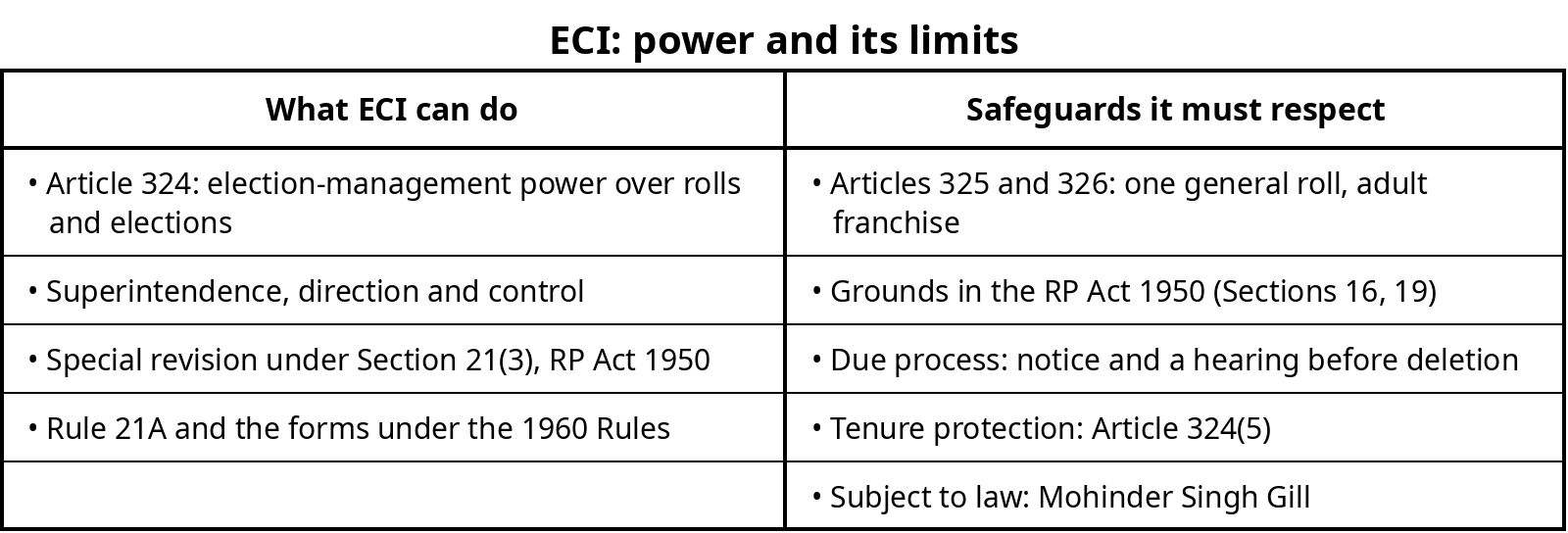
This is the centre of the topic. I would draw two columns in my notes: what ECI can do, and what safeguards it must respect.
Start with the Constitution
Article 324 gives ECI superintendence, direction and control over electoral rolls and elections. But power does not mean freedom from the law.
Article 325 tells us there is one general electoral roll and bars exclusion on grounds of religion, race, caste or sex. Article 326 gives us adult suffrage. Put them together and the task becomes clear: maintain an accurate roll without shutting out eligible citizens.
Articles 327 and 328:
deal with election law-making by Parliament and, where Parliament has not made provision, State legislatures.
This is why a dispute over an online form can become a rule-of-law question.
A portal is a way of implementing the rules, not a substitute for changing them through the proper legal process.
Then add the law
Representation of the People Act, 1950, Section 16
deals with disqualifications for registration and Section 19 with the age and ordinary-residence conditions. Section 21 deals with preparation and revision of rolls.
For SIR, remember
Section 21(3): ECI can direct a special revision, but it must record its reasons. That phrase matters. It gives a court something to examine instead of leaving the decision at ‘because the Commission said so’.
The Registration of Electors Rules, 1960 supply the procedure and forms. Rule 21A is relevant to deletion; notice and an opportunity to be heard are safeguards, not optional paperwork.
What did the May judgment settle?
The Court accepted ECI’s authority to carry out Bihar’s SIR within the statutory framework.
Migration, urbanisation &the need to check eligibility were part of the reasons examined.
It also treated the draft roll as provisional. The stages for claims and objections mattered, because non-inclusion in a draft could still be challenged.
The citizenship distinction is worth slowing down for.
ECI can examine eligibility for enrolment, including citizenship as a condition. But its electoral decision is not a final determination of citizenship under the Citizenship Act. Those are different functions, with different authorities.
So I would write the lesson this way:
wide power, recorded reasons, fair procedure and judicial review. ‘SIR upheld’ does not make those safeguards disappear.
If you want to connect older cases, use Mohinder Singh Gill for Article 324’s breadth and A.C. Jose for the point that ECI cannot act against a valid law. Do not turn the answer into a parade of case names. Explain the limit each case helps you see.
And what about ECI’s independence?
Independence is about how decisions are made as well as how Commissioners are appointed or removed. Article 324(5) protects the CEC’s removal in the same manner as a Supreme Court judge; removal of the other ECs requires the CEC’s recommendation. Their protection is different, not absent.
The current petition raises questions about decision-making within a multi-member Commission. Keep collegiality and transparency in your answer, but do not present a petitioner’s allegation as a proved finding.
5. History: why an electoral roll is more than a list
The historical contrast is simple. Under the colonial reforms of 1909, 1919 and 1935, voting remained restricted, even as the electorate widened. Property, tax and other qualifications decided who could participate; separate electorates divided representation.
Independent India chose a different starting point: universal adult franchise, without a property or literacy test. Articles 325 and 326 make more sense when you read them against that background.
But a constitutional promise still has to reach a person’s name on a list. During the first general election under Sukumar Sen, the problem of women being recorded only as someone’s wife or daughter showed how an administrative practice could affect inclusion.
That is the connection I want you to retain
A roll is where the promise of political equality meets the actual work of administration.
Intensive revision itself is not new. Bihar’s previous exercise in 2003 is part of the present case’s background. The debate is about this exercise’s design and safeguards, not simply whether rolls may ever be checked.
6. Economy and development: look at the person behind the entry
Imagine a worker who leaves home for a job in another city.
That is an illustration, not a reported case.
For the administration, the move can create a stale entry at one address. For the worker, it can mean being absent when someone comes to verify it.
The same migration that makes a roll harder to maintain can make an eligible voter harder to reach. A good answer needs both sides.
Documents also have a cost. A certificate may look like a small requirement on paper; obtaining it can mean travel, fees, office visits and a lost day’s wages. I would connect this to state capacity: can the administration help people establish eligibility, or does it only ask them to produce papers?
Accurate rolls help election planning. But keep the databases separate. The electoral roll, Aadhaar, PDS and DBT systems serve different purposes. Aadhaar is not proof of citizenship, and enrolment on a voter roll should not be casually treated as the test for every welfare scheme.
There is an administrative cost too. Field verification uses staff time and public resources. The development question is how to do that work well without making access hardest for people with the least time and money to spare.
7. Governance and ethics: two ways to get it wrong
A roll can include someone who is ineligible. It can also exclude someone who is eligible. Both are errors. Only talking about ‘cleaning up’ the list hides the second one.
Now think about the timing. If an eligible person’s name is missing on polling day, a correction later cannot give them that vote back.
That is why notice, a hearing and a real chance to correct an error matter so much.
The burden-of-proof question sits here too. What should the person show? What should the state verify? A fair process cannot assume that difficulty producing a document automatically settles the eligibility question.
For GS 4, bring this down to the officer dealing with the applicant. Can the BLO explain the requirement to an elderly person? Can someone who cannot read get help? Does the officer have enough time and training to check carefully rather than just finish a target?
Empathy does not mean ignoring the law. It means helping people use the process the law provides, recording reasons and making decisions open to challenge.
Transparency helps both sides. Clear reasons for proposed deletions and an accessible correction process make it easier to spot errors. They also make the Commission’s work easier to trust.
8. For the exam: what I would actually revise
For Prelims
Keep the core distinctions together: Article 324 is ECI’s election-management power; Article 325 is the general-roll and non-exclusion provision; Article 326 is adult suffrage. The voting age is 18, lowered by the 61st Amendment, 1988.
Remember Section 21(3) for special revision. Then pair each form with its task: 6 for inclusion, 7 for objection/deletion, 8 for changes to an existing entry.
Do not let an identity document become citizenship proof in your notes.
Do not let an oral observation become a judgment.
The May 2026 SIR judgment and the October 2026 Form 6 observation answer different questions.
For Mains
I would practise questions that force you to explain a tension, rather than reproduce the timeline:
How can Article 324 give ECI wide powers while keeping it subject to the law?
How should electoral-roll verification balance accuracy with inclusion, especially for migrant workers?
Where does ECI’s inquiry into enrolment eligibility end, and a final determination of citizenship begin?
In a GS 4 case, how would you help an applicant struggling with documents without bypassing the prescribed process?
For an answer, start with the Form 6 dispute in a line. Explain the constitutional and statutory basis, then the May judgment. Add the concerns about exclusion, documents and institutional decision-making. End with practical safeguards: reasons, notice, hearings, help with applications and a usable correction process.
My closing point would be this: a clean roll and an inclusive roll are not opposites. The administration has to deliver both.
What is still open?
The Court still has to examine the records about the Form 6 changes. Do not predict its conclusion. Follow the next order, and distinguish what the Court decides from what either side claims.
For revision, this topic is useful because it connects one small form to constitutional power, political equality, migration and fairness in administration. That is the blog’s takeaway, not a pile of press-release dates.
Sources used
ECI’s voter-registration guidance and forms; the Supreme Court’s Bihar SIR judgment of 27 May 2026; PIB’s Phase II release; and The Indian Express’s reporting on the 5 October Form 6 hearing. The news dispute remains pending.
Join my Telegram for more CSEWhy explainers and revision resources: Join CSEWhy on Telegram