

Narendra Modi. Ajit Doval. Shaktikanta Das.
You know these names.
But put them in one question: what actually happens inside the Prime Minister's Office?
Suddenly, the answer becomes less obvious.
Does the PMO run every ministry? Does it implement every scheme? Is it mentioned in the Constitution?
I want to untangle this without turning it into a list of designations you forget tomorrow
Because the most useful way to understand the PMO is to understand what it ISN'T
First, the PMO is not a ministry
Think of the Prime Minister as the person who has to see the bigger picture.
A ministry sees its own subject. The PM has to see how those subjects fit together.
The PMO is the team that helps him do that:
secretarial assistance, advice, coordination and follow-up.
It does not become the Ministry of Railways because the PM reviews a railway project. It does not become the Ministry of External Affairs because a foreign-policy file reaches the PM.
My shorthand: support the PM, coordinate the system, track the work.
Monitoring a scheme is not the same as implementing it. The ministry still has a job to do.
So, who sits around PM Narendra Modi?
Start with the names, then attach the roles.
1/ P. K. Mishra is the Principal Secretary to the PM
The PMO's official disclosure says the Principal Secretary heads the office.
2/ Shaktikanta Das is Principal Secretary-2 to the PM
These are senior officials supporting one political head
3/ Ajit Doval is the National Security Adviser.
That is the security-advice role, not a replacement for the Defence Ministry or External Affairs Ministry.
4/ Dr. Jitendra Singh is Minister of State in the PMO
This is a political position, different from the civil-service posts above.
There are also advisers, additional secretaries, joint secretaries, directors, private secretaries and officers handling specific subjects.
Don't picture one person reading every file. Picture a team organising information so the PM can take decisions.
What would a day of work look like?
Here is an imaginary example
A major road project is stuck. One department is waiting for a clearance. A state has a land-related issue. Another agency has a different deadline.
Nobody solves this by announcing a new scheme.
Someone has to bring the information together, identify the bottleneck, get the right officials talking and check whether the promised action happened.
That is the kind of coordination and monitoring the PMO helps with!
PRAGATI makes this easier to picture. Its full name is Pro-Active Governance And Timely Implementation
The official launch note describes a platform bringing Union government secretaries and state chief secretaries into reviews with the PM, using data, video-conferencing and geo-spatial information.
Projects. Programmes. Public grievances. Follow-up.
The PMO also supports the PM's communication and work on important policy, foreign affairs and security matters.
My point: a review meeting is useful only if somebody tracks what happens AFTER it.
Does every file go to the PM?
No. This is where the official PMO disclosure is especially useful.
If a ministry has its own Cabinet Minister or Minister of State in charge, most matters are dealt with there. Important policy issues are submitted to the PM for orders or information under the relevant rules.
If the PM himself holds a portfolio, matters needing ministerial approval go to him unless that authority has been delegated.
So the route depends on the subject, the rules and who holds the portfolio.
PMO does not mean every government file lands on one desk.
Wait, the PM has portfolios too?
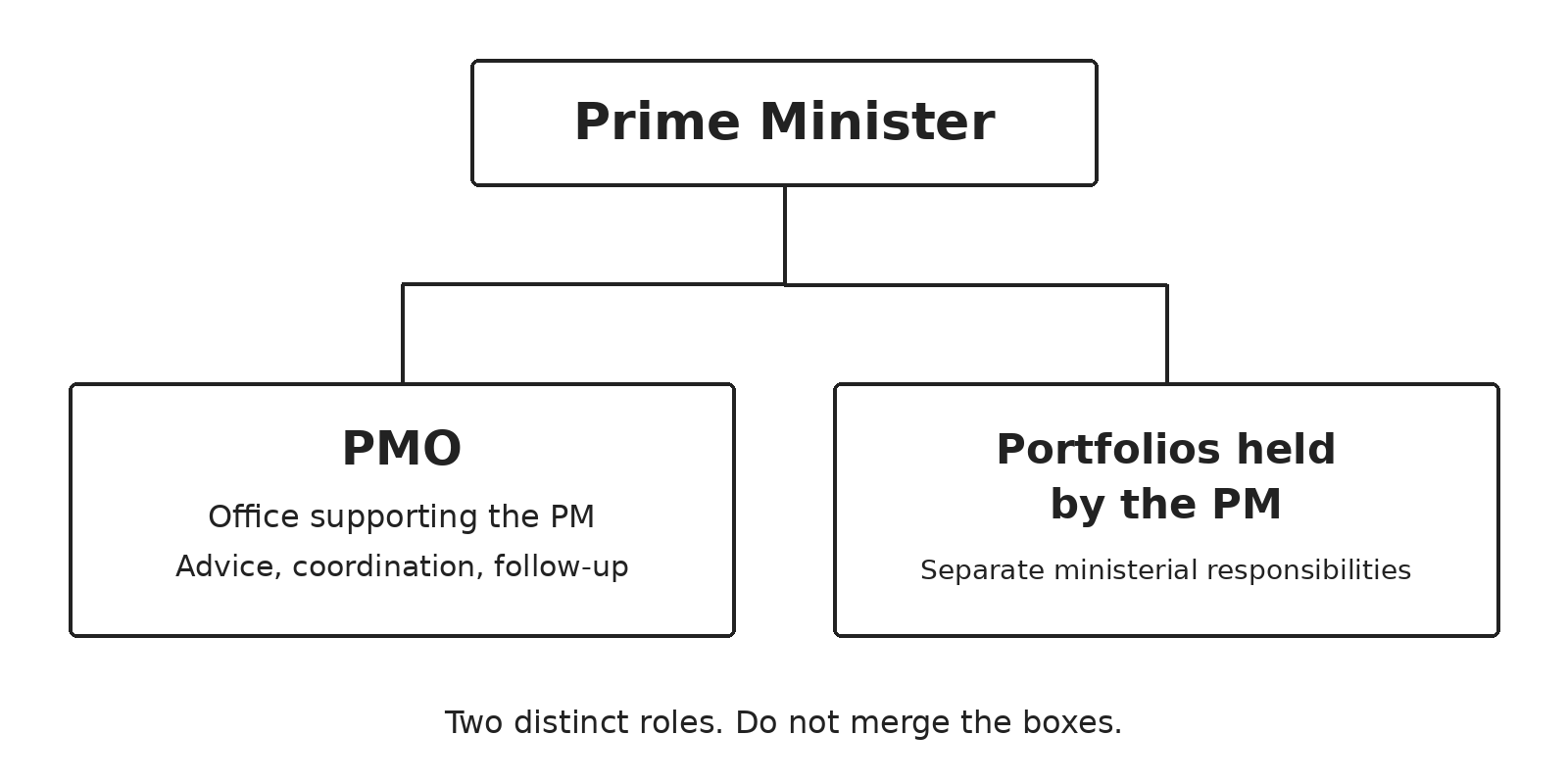
Yes. Keep the person and the office separate.
Sh. Narendra Modi's listed responsibilities as PM include:
Ministry of Personnel, Public Grievances and Pensions
The Department of Atomic Energy
The Department of Space
He also handles all important policy issues and portfolios not allocated to another minister.
But that does NOT turn those departments into branches of the PMO.
For revision, I would draw two boxes: one labelled PMO, the other labelled portfolios held by the PM.
Connect them to the Prime Minister. Don't merge the boxes.
Where does the Constitution come in?
The PMO is not itself a constitutional body. The Constitution's framework for the Prime Minister and Council of Ministers is different from the office that supports the PM.
This PDF of Notes on this topic connects this topic to Articles 74-78. Article 77(3) is the link to rules for government business.
For the PMO's actual working, remember
a) The Government of India (Allocation of Business) Rules, 1961
b) The Government of India (Transaction of Business) Rules, 1961.
Also keep the Cabinet Secretariat separate.
Support to the PM and support to the Cabinet are related jobs, not identical institutions.
And one small history correction worth remembering
The PMO's official disclosure says the Prime Minister's Secretariat was set up on 15 August 1947. It was renamed the Prime Minister's Office on 28 March 1977.
The 1964 phase under Lal Bahadur Shastri matters for its more formal status under the business rules. It does not mean there was no Secretariat before him.
The dashboards are not all owned by the PMO
PRAGATI, CPGRAMS, e-SamikSha and PM GatiShakti.
Think of their jobs separately:
Project and programme review
Public-grievance tracking
Follow-up on decisions
Integrated infrastructure planning.
The ownership matters too. DARPG with CPGRAMS, the Cabinet Secretariat with e-SamikSha, and DPIIT with PM GatiShakti.
A platform being used for a review at the top does not make it a PMO department.
The same rule applies to NITI Aayog, the Inter-State Council and NDMA. The PM chairs these bodies, but they are not interchangeable with his office.
What should you carry into UPSC revision?
PMO = staff and secretarial support to the Prime Minister
Principal Secretary = administrative head of the office
PM's portfolios = subjects held by the PM, not ministries absorbed into the PMO
Coordination and monitoring = different from direct implementation
PMO and Cabinet Secretariat = separate institutions
PRAGATI = a useful example of review, coordination and follow-up
For a GS2 answer, I would use this distinction to discuss the balance between faster coordination and excessive centralisation.
The benefit is clear: cross-ministry problems can get attention at the top. The question to ask is whether that strengthens delivery while keeping ministries responsible for their own work.
Sources and reading
This explainer builds on the CSEWhy PMO PDF
Official references checked for the institutional role, officers, portfolios and PRAGATI:
https://www.pmindia.gov.in/en/proactive-disclosure-under-section-4-1-b-of-the-rti-act-2005/
https://www.pmindia.gov.in/en/list-of-officers-pmo/
https://www.pmindia.gov.in/en/news_updates/portfolios-of-the-union-council-of-ministers-2/
https://www.pmindia.gov.in/en/news_updates/pm-launches-pragati-a-multi-purpose-multi-modal-platform-for-pro-active-governance-and-timely-implementation/