

UPSC turns 100 today.
But the useful part of this news is not the commemorative coin. It is the question being asked of the institution: what kind of civil servant should India select for its next 25 years?
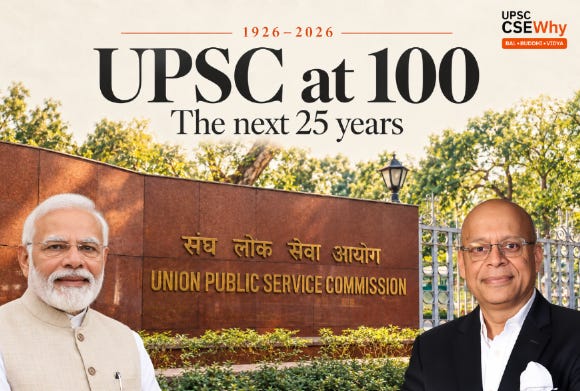
At Bharat Mandapam on October 1, PM Modi spoke about public service, faster examination cycles and the cost of delays. A day earlier, UPSC Chairman Dr. Ajay Kumar spoke about reasoning, spontaneous thinking and judgment under ambiguity.
Read these together. Then separate what was said from what has actually changed.
1. First, get the 100 years right
India's first Public Service Commission was established on October 1, 1926. It was an advisory body under British rule.
It became the Federal Public Service Commission in 1937.
On January 26, 1950, it became the Union Public Service Commission
So the centenary marks 100 years of the institution's journey. It does not mean UPSC has been a constitutional body since 1926.
The year-long centenary celebrations began on October 1, 2025. The September 30-October 1, 2026 programme marks their culmination.
Today, PM Modi released a commemorative coin, a stamp and the book 100 Landmark Judgements: Shaping the Policies of UPSC and Public Service Commissions in India.
Read PIB's September 30 backgrounder:
https://static.pib.gov.in/WriteReadData/specificdocs/documents/2026/sep/doc_10038_20260930_11521201.pdf.
2. What PM Modi actually said
Three parts of the speech matter for your preparation.
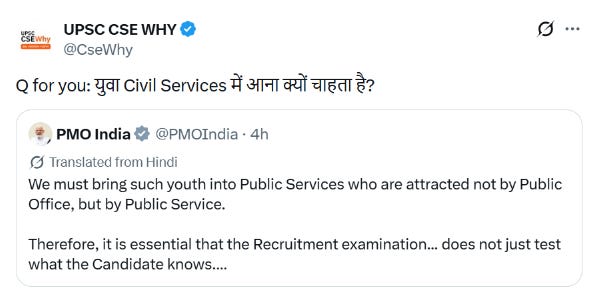
1. Public service, not public office
He said recruitment should look beyond what a candidate knows and examine why the candidate wants to enter the civil services. His two touchstones were "Nation First" and "Citizen First".
That is a useful question to ask yourself. Strip away the designation, the authority and the social approval. What work do you actually want to do?
2. Time certainty
PM Modi asked examination agencies to shorten their cycles without lowering standards. He connected delays to coaching fees, rent and transport costs borne by families.
His point: a faster examination cycle is an equity issue, not merely an administrative convenience. In the original speech, he said: "यह एक equity reform भी होगा।"
3. Judgment for new problems
He referred to deepfakes, information warfare, algorithmic bias and climate justice, and called for greater attention to complex problem-solving and foresight in selection.
For GS4, that is a direct link between technology and administrative ethics. Knowing the definition of algorithmic bias is the starting point. Deciding what an officer should do when a biased system denies someone a benefit is the real exercise.
Read today's PIB account of the speech:
https://www.pib.gov.in/PressReleasePage.aspx?PRID=2317531. Read the original speech:
https://pib.gov.in/PressReleasePage.aspx?PRID=2317535.
3. What the UPSC chairman did
At the September 30 "Manthan" programme, Dr. Ajay Kumar set out three guiding principles:
3T: Trust, Transparency and Technology
The most relevant part for aspirants was his emphasis on assessing reasoning, spontaneous thinking and judgment under ambiguity, rather than the reproduction of predictable or coached model answers.
He also outlined a proposed Centre of Excellence for collaboration with State Public Service Commissions and referred to UPSC's partnership with NALSAR, Hyderabad, for the compendium of 100 landmark judicial verdicts.
PIB's release also records reforms already introduced, including digital e-admit cards, face authentication, the Candidate Helpdesk, expanded examination centres and measures relating to provisional answer keys and the QPRep portal.
Read the September 30 chairman release:
https://www.pib.gov.in/PressReleasePage.aspx?PRID=2317336. Read the October 1, 2025 launch release:
https://www.pib.gov.in/PressReleasePage.aspx?PRID=2173688.
4. Does this mean the exam pattern has changed?
Do not turn a speech into an exam notification.
The remarks above set out a direction for recruitment reform. They do not, by themselves, announce a new CSE syllabus, a different marking scheme or a changed interview format.
Any such change needs the relevant official notification. Do not rebuild your preparation around a headline.
The sensible response is simpler: continue the syllabus and PYQs, but stop treating a model answer as something to reproduce word for word.
5. The polity revision hidden in this news
Revise Part XIV, Articles 315-323. Keep this short map:
- 315: Public Service Commissions for the Union and the States.
- 316: Appointment and term of office of members.
- 317: Removal and suspension of members.
- 320: Functions, including examinations and advice on recruitment, promotions and disciplinary matters.
- 322: Expenses charged on the relevant Consolidated Fund.
- 323: Reports and accountability, including explanations where advice is not accepted.
UPSC is more than the Civil Services Examination. Its work includes other examinations, recruitment for specialist posts, promotions and advice on service matters.
For a mains answer, connect independence with accountability, and merit with equal opportunity. Recruitment can be formally open yet practically difficult to access because of cost, distance or disability. That is where institutional reform matters.
6. One exercise for today
Write 150 words on this:
"Reducing delays in public recruitment is an equity reform. Discuss."
Use the cost borne by candidates as your starting point. Then cover predictable calendars, examination integrity, access and grievance handling. End with the need to reduce delay without lowering standards.
After that, write a private five-line answer to:
Why do I want to join the civil services?
No interview polish. No borrowed answer. Just yours.
A hundred years of UPSC is worth knowing. What you do with the news matters more.
keep going and join my on Telegram below