

Articles of the Constitution look like random numbers. They’re not.
There are patterns, sounds and stories hidden in them. Once you see them, you don’t need to mug up. You just remember.
Here are 8 tricks I use. Each one has examples you can learn right now
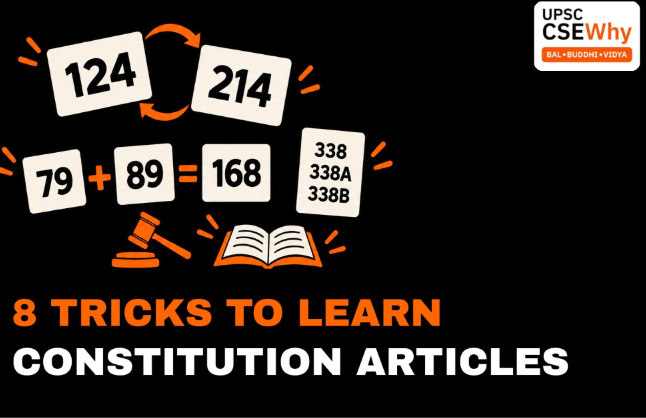
1. The 1-2 interchange trick
Swap the 1 and the 2. Union becomes State.
124: Supreme Court. 214: High Court.
123: Ordinance power of the President. 213: Ordinance power of the Governor.
Hogya yaad!
2. The number 89 trick
Many Parliament articles have a State legislature twin exactly 89 numbers later.
79: Constitution of Parliament. 79 + 89 = 168: Constitution of State legislature.
87: Special address by the President. 87 + 89 = 176: Special address by the Governor.
Learn the Parliament block (79-122) and you get a head start on the State block too.
3. One number, three articles
338: National Commission for Scheduled Castes
338A: National Commission for Scheduled Tribes
338B: National Commission for Backward Classes
4. Common slang
Article 50: separation of judiciary from executive. 50-50 is how we split things. Split powers.
Article 143: advisory jurisdiction of the Supreme Court (President can seek its opinion). You know what 143 means in texting language. The President is asking the SC for advice with love.
5. Similar sounds
243I: State Finance Commission to review Panchayat finances. The “i” in f-i-nance.
243K: elections to Panchayats. Ele-K-tion.
Fundamental Rights available only to citizens: 15, 16, 19, 29, 30. Read them in Hindi: Pandrah, Solah, Unnees, Untees, Tees. They rhyme. You won’t forget.
6. Connected themes
Group articles that belong to one idea. Example: the institutions often called bulwarks of the Constitution.
76: Attorney General
148: CAG
315: UPSC
324: Election Commission
7. Mnemonics
Articles 14-18: E-DOUT
14: Equality before law
15: no Discrimination
16: equal Opportunity
17: Untouchability abolished
18: Titles abolished
All my Fundamental Rights mnemonics are here on X.
8. Contextual learning
This is the most powerful one. Every time something is in the news, ask: which article is behind this?
A law passed to fulfil an international treaty (like the Antarctica Act)? Article 253: Parliament can legislate to implement international agreements.
Supreme Court doing “complete justice” in a big judgment? Article 142.
Multi-State Cooperative bill? Article 43B: promotion of cooperative societies.
Belagavi dispute between Maharashtra and Karnataka? Article 263: Inter-State Council. Bonus: 262 is for inter-state river water disputes.
Governor’s address row in a State? Article 176.
Delhi LG vs elected government? Article 239AA, added by the 69th Amendment (1991).
An MP can’t be sued for defamation over a speech in the House? Article 105. And Parliament can’t discuss a judge’s conduct except in removal proceedings: Article 121.
News gives you the story. The story holds the number.
How to use these
Don’t read all 8 today. Take 2 tricks a day. Say the examples out loud.
On day 5, test yourself on all of them.
Build your own. Every time you find a pattern, write it down.
Get the full Tricks PDF
The complete version is a free PDF: Tricks to Learn Constitution Articles. All 8 tricks, plus the articles that came up in the news after them, grouped topic-wise and checked against the current Constitution.
Download it free on our Telegram: t.me/csewhy
Want the original thread? Read it on X.
Keep going,
CSEWhy