

How do you get better at Articles of the Constitution?
Not by reading Laxmikanth one more time.
Write 100+ important articles on A4 sheets.
Paste them on your wall. Revise regularly.
That’s it. That’s the method. I shared it on X a while back, and it still works better than any app. Here’s how to do it properly?
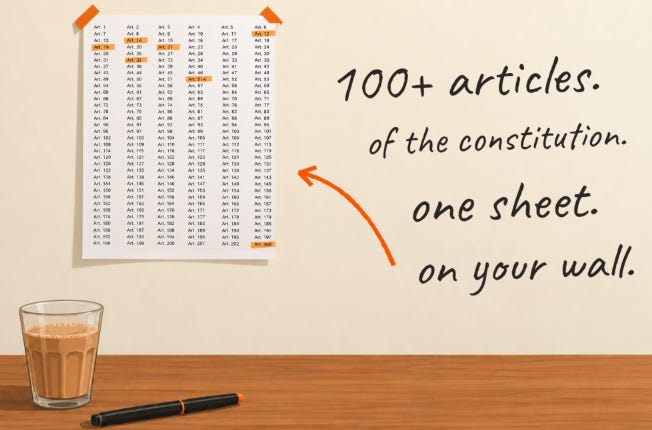
Why the wall works
Articles are pure recall. Prelims asks you to match a number to a provision in seconds. Mains rewards you for quoting the right article in the right line.
Recall comes from seeing the same thing again and again, without effort. A wall does that for you. You see it when you wake up, when you drink water, when you’re stuck on a topic. Ten seconds each time. That adds up.
Step 1: Pick your 100+ articles
Don’t try to write all of them. Pick the ones UPSC keeps coming back to. A good starting set:
Union and citizenship: 1, 3, 5-11
Fundamental Rights: 12-35 (don’t skip 21A and 32)
DPSP and Duties: 36-51, 51A
Union Executive: 52-78 (72, 74, 75, 76)
Parliament: 79-122 (108, 110, 112, 123)
Judiciary: 124-147 (137, 141, 142, 143)
States: 152-237 (163, 213, 226)
Local bodies: 243 series
Centre-State relations: 245-263, 280
Services, elections, emergency, amendment: 312, 315, 324, 326, 352, 356, 360, 368
Step 2: Write by hand, part by part
Go Part-wise. One sheet can hold a few Parts. My own set was four handwritten A4 sheets: a map of the Parts, Part I to Part XVIII, the Schedules and a flowchart on amendability.
Rules for writing:
Number on the left, 3-6 words on the right. “324: Election Commission”. Not a paragraph.
Write it yourself. Printing it defeats half the purpose. Writing is the first revision.
Use one colour for the number and another for the provision.
Step 3: Add memory hooks on the sheet
Put mnemonics right next to the articles. Example for 14-18, E-DOUT:
14: Equality before law
15: no Discrimination
16: equal Opportunity in public employment
17: abolition of Untouchability
18: abolition of Titles
Add the 12 Schedules at the bottom of one sheet, and a small flowchart for amendment cases (Shankari Prasad to Minerva Mills). These are the things you forget first.
Step 4: Paste where you can’t avoid it
Next to your study table, or the wall you face while studying. Not behind the door.
Step 5: Revise like this
Daily, 2 minutes: read one sheet top to bottom.
Weekly: cover the right side with a paper. Say the provision from the number. Then flip it: see the provision, recall the number.
When an article is in the news: circle it. Write the news in one line next to it. That’s your Mains example sorted.
Step 6: Keep the sheet updated
The Constitution changes. Old notes don’t. A few I see wrong in many aspirants’ notes:
Article 45 is now early childhood care. Free education for 6-14 moved to 21A.
Article 370 and 35A: inoperative since 2019.
Failure of constitutional machinery in a UT is 239AB, not 239A.
Article 262 is inter-state water disputes.
Anglo-Indian nomination under 331/333 lapsed in 2020.
Article 334 reservation of seats now runs for 80 years, till 2030.
Don’t want to start from zero?
I’ve turned my wall sheets into a free PDF: Important Articles of the Constitution. Part-wise, with the mnemonics, the 12 Schedules and the amendability flowchart, updated to the current Constitution.