

India went from 1.5% ethanol blending to 20%, achieving a major milestone.
However, the rollout has also triggered an intense debate over vehicle compatibility, fuel efficiency, food-versus-fuel concerns, and the long-term impact on agriculture and consumers.
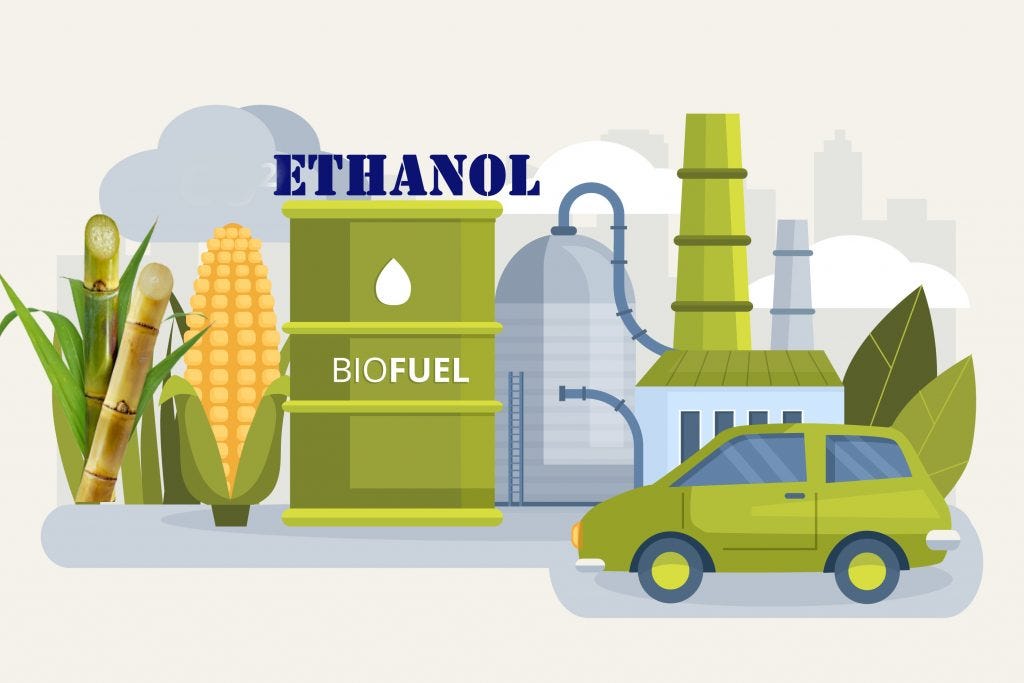
WHAT IS ETHANOL BLENDING?
Ethanol can be produced by fermenting sugars and starches and then distilling the fermented material.
Ethanol blending refers to mixing ethanol, a plant-based biofuel, with petrol.
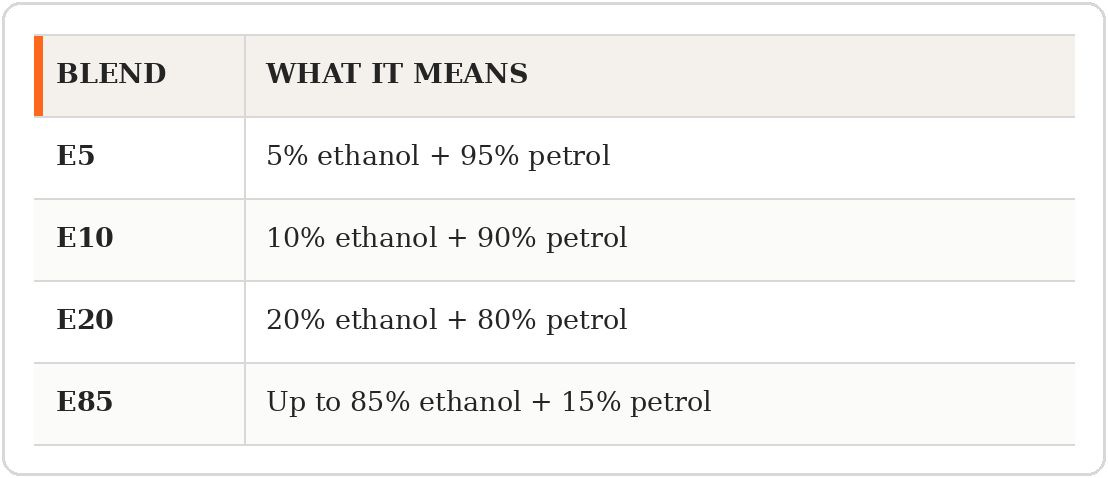
So what changes when the ethanol share rises?
Ethanol has a relatively high octane number, making it useful as a blending component. But it also contains less energy per litre than petrol. For vehicles designed around lower blends, higher ethanol concentrations can therefore affect fuel economy.
But there is another question: where does the ethanol come from?
• 1G ethanol is produced from sugar- and starch-rich feedstocks such as sugarcane, molasses, maize and rice.
• 2G ethanol uses agricultural residues such as rice straw and bagasse.
• 3G and other advanced pathways explore feedstocks and technologies such as algae that can reduce dependence on conventional food crops.
HOW ETHANOL IS PRODUCED
FIRST-GENERATION (1G) ETHANOL
1G ethanol is produced from sugar- and starch-based feedstocks such as sugarcane juice, molasses, maize and rice.
The process:
Feedstock preparation → Fermentation → Distillation → Dehydration
Yeast converts fermentable sugars into ethanol. Water is then removed to obtain anhydrous ethanol suitable for petrol blending.
The challenge: Food-versus-fuel concerns.
SECOND-GENERATION (2G) ETHANOL
2G ethanol is produced from lignocellulosic biomass such as rice straw, wheat straw, bagasse and bamboo.
It requires an additional pre-treatment stage to break down tough plant fibres before fermentation. It can reduce dependence on food crops and convert agricultural waste into fuel.
The advantage: It converts agricultural waste into clean fuel.
The shift now should be from 1G to 2G ethanol.
Instead of relying mainly on food crops, India can turn agricultural waste like rice straw and bagasse into fuel. Less food-versus-fuel conflict, less stubble burning, and more value for farm waste.
ETHANOL IS NOT AN INDIAN EXPERIMENT
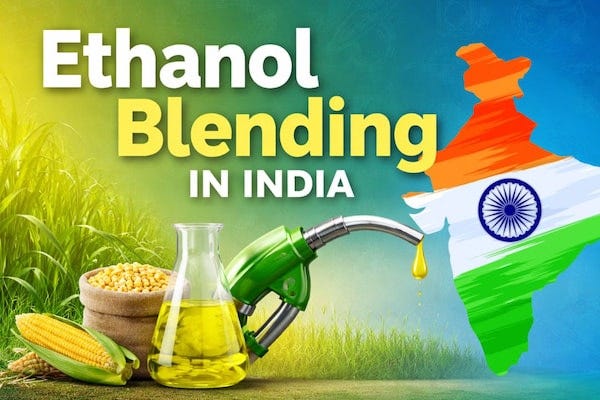
Brazil introduced it first in 1975 with a 5% ethanol blend in petrol. The National Alcohol Programme (Proálcool) was launched after the global oil crisis to promote ethanol as an alternative transport fuel.
Further along this path than any other large economy, Brazil mandates E27 today and is moving toward E30, with most new cars sold there being flex-fuel capable.
The United States has run on E10 as a national standard for years and E15 is now expanding, with a flex-fuel fleet already capable of running on blends as high as E85.
Japan has taken a more gradual route through a phased E10 rollout, while Canada, Thailand and several European countries have built ethanol into their fuel strategies too.
India is using decades of global ethanol experience rather than relying on faith alone.
DOES INDIA REALLY NEED ETHANOL?
India needs energy. But it is dependent on crude oil that comes from outside India.
This creates exposure to global oil prices, wars, geopolitical disruptions, shipping shocks and exchange-rate movements.
Every increase in crude prices can therefore put pressure on both India’s import bill and its foreign-exchange outflows.
Ethanol offers one way to reduce that dependence.
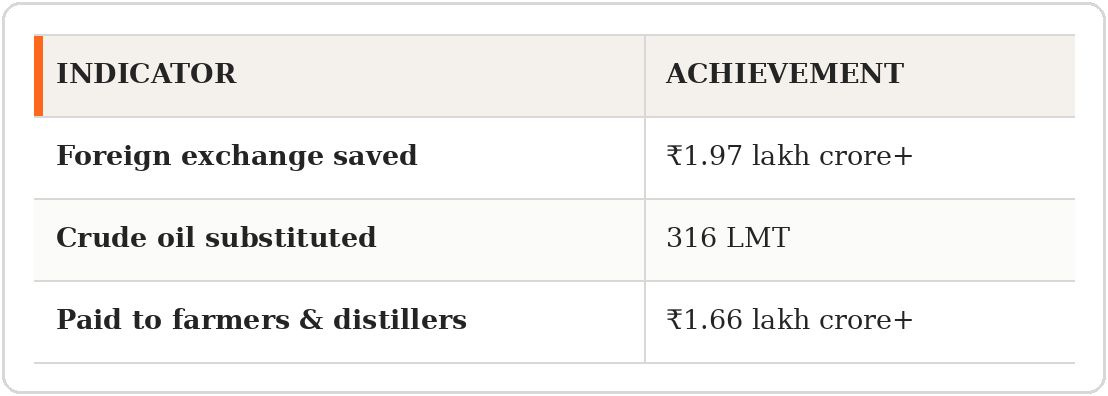
But the benefits do not stop at the oil import bill. One litre of ethanol connects multiple markets.
For energy security: Less petroleum needs to be imported.
For farmers: Crops such as sugarcane and maize get an additional demand channel.
For the sugar industry: Ethanol provides an alternative market when sugar production is in surplus, helping stabilise the sector.
For the environment: Ethanol is bio-based rather than fossil-based.
The achievement of today had its seeds sown in the 2000s.
INDIA’S ETHANOL JOURNEY
2003 → Ethanol Blended Petrol (EBP) Programme launched
Started with the goal of blending 5% ethanol with petrol as a pilot project in a few states.
2006 → Ethanol blending made mandatory in select states
The programme expanded, but progress remained slow due to supply and pricing constraints.
2013–14 → Only 1.53% ethanol blending
India’s ethanol programme was still at an early stage.
2018 → National Policy on Biofuels
Expanded the range of feedstocks and gave a major policy push to ethanol production.
2020s → Rapid scale-up
Higher procurement support, new feedstocks and distillery expansion accelerated blending.
2023–24 → 14.6% blending achieved
2024–25 → 19.2% blending achieved
2025–26 → 20% blending milestone
India’s ethanol journey moved from 1.53% to 20% blending in just over a decade. More feedstocks meant more ethanol, which meant higher blending targets.
And that’s where India’s ethanol story takes an interesting turn, because every milestone comes with new challenges.
WITH E20: WHO GAINS? WHO PAYS?
First, the obvious gain: fewer oil imports. More domestic ethanol means less petroleum to import, strengthening energy security.
But there is another side.
• The mileage trade-off: E20 has lower energy content than petrol, meaning slightly lower mileage and potentially higher refuelling costs.
• Food vs fuel: Greater reliance on food-linked feedstocks can create trade-offs and distort agricultural incentives.
• Vehicle compatibility is another challenge, especially for older vehicles.
But the economics do not stop at the petrol pump.
• For sugar mills, ethanol can provide an additional revenue stream and improve cash flows.
• For maize farmers, assured demand can support better price realisation.
• For the government, greater domestic ethanol use can reduce the need for imported petroleum.
• For the economy, a larger domestic ethanol industry means more production, processing, storage and transportation activity within India.
E20 is neither a simple win nor a simple cost.
Its success will depend on whether India can balance energy security, farmer incomes, food security, consumer costs and vehicle compatibility, all at the same time.
INDIA’S WAY FORWARD: MAKE E20 WORK BETTER
India has already crossed the difficult part: building an ethanol ecosystem at scale.
The next challenge is making sure that growth does not create new vulnerabilities.
1. Diversify the feedstock basket. India should avoid becoming overly dependent on sugarcane and continue expanding alternatives such as maize and other suitable feedstocks.
2. Align energy and agricultural policy. If ethanol creates strong incentives for certain crops, policies must also encourage the production of pulses, oilseeds and other crops India needs.
3. Go beyond conventional feedstocks to 2G ethanol. NITI Aayog specifically recommends promoting advanced biofuels, including 2G ethanol, to avoid the food-production trade-off.
4. Make the transition fair for consumers. Better vehicle compatibility, transparent pricing and clear communication can help ensure that the costs of E20 are not disproportionately borne by motorists.
5. Keep looking beyond E20. Future moves should follow the evidence on vehicle compatibility, feedstock availability and food-security considerations.