

Imagine Earth as one giant classroom.
The Sun is the teacher.
The oceans are students.
And the atmosphere?
It’s basically the gossip network through which everybody talks to everybody else.
Now here’s something interesting.
Even though the Pacific Ocean is thousands of kilometres away from India, what happens there can decide:
Whether India gets good monsoon rains.
Whether droughts occur.
Whether food prices rise.
Whether floods become more common.
Sounds crazy, right?
Welcome to the fascinating world of El Niño and La Niña.
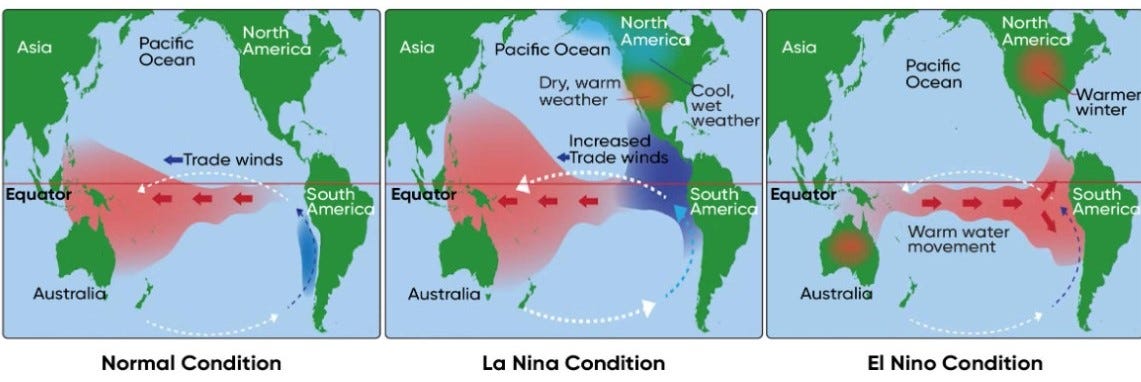
First, let’s understand normal conditions
Picture a swimming pool.
Suppose you keep blowing air from one side.
Eventually, the water gets pushed towards the opposite side.
Something similar happens over the Pacific Ocean.
Normally, strong winds called trade winds blow from South America towards Australia and Indonesia.
These winds push warm water westward.
As a result:
Western Pacific (Indonesia, Australia)
Warm water accumulates.
More clouds form.
Heavy rainfall occurs.
Eastern Pacific (Near Peru)
Cold water rises from deep below.
Less rainfall occurs.
Everything remains balanced.
This is the “normal” condition.
Then enters El Niño
Think of El Niño as a lazy day.
The trade winds become weak.
Because the winds weaken, they can no longer push warm water towards Asia effectively.
So what happens?
The warm water starts moving back toward South America.
This completely changes rainfall patterns across the world.
Countries that usually receive rainfall may become dry.
Countries that are normally dry may receive excess rain.
Nature essentially reshuffles the weather cards.
Simple analogy
Imagine you are holding a bucket full of water.
Normally, you tilt it to the right.
Water collects there.
Now suddenly you stop tilting.
Water spreads back.
That’s exactly what El Niño does.
Why does India worry about El Niño?
Because India’s monsoon depends on temperature differences between land and ocean.
During El Niño years:
Monsoon winds weaken.
Rainfall often decreases.
Drought conditions may emerge.
Agricultural output suffers.
Food inflation may rise.
This is why economists, farmers and governments all closely monitor El Niño.
Quick Note ✍️
El Niño generally means:
Hotter temperatures.
Weaker Indian monsoon.
Less rainfall.
Drought-like conditions.
Higher chances of food inflation.
Now meet La Niña
If El Niño is the lazy version,
La Niña is the overachiever.
During La Niña, the trade winds become stronger than usual.
They push even more warm water towards Australia and Indonesia.
Meanwhile, even colder water rises near South America.
This strengthens the normal pattern.
As a result:
Rainfall increases in many regions.
Indian monsoon often becomes stronger.
Flood risks rise.
Cyclone activity may increase.
Another analogy
Suppose you are pushing a swing.
Normal push = Normal conditions.
Weak push = El Niño.
Very strong push = La Niña.
Simple.
Why are these names so strange?
Spanish fishermen near Peru noticed that unusually warm water appeared around Christmas.
They named it El Niño, which means:
“The Little Boy” or “Christ Child.”
Later, scientists discovered the opposite phase and called it La Niña, meaning:
“The Little Girl.”
So, who wins?
Neither.
Both create problems.
El Niño
Can bring:
Droughts.
Heat waves.
Water shortages.
Crop failures.
La Niña
Can bring:
Floods.
Excess rainfall.
Strong cyclones.
Landslides.
Nature likes balance.
Too much of anything is dangerous.
But why do they happen?
Scientists still don’t fully understand every detail.
However, they know that oceans and atmosphere continuously interact.
Sometimes the system weakens.
Sometimes it strengthens.
These changes happen every 2–7 years and can last for several months.
Together, scientists call this phenomenon:
ENSO
(El Niño Southern Oscillation)
Think of ENSO as a pendulum.
It swings between:
El Niño
Neutral
La Niña
And then repeats.
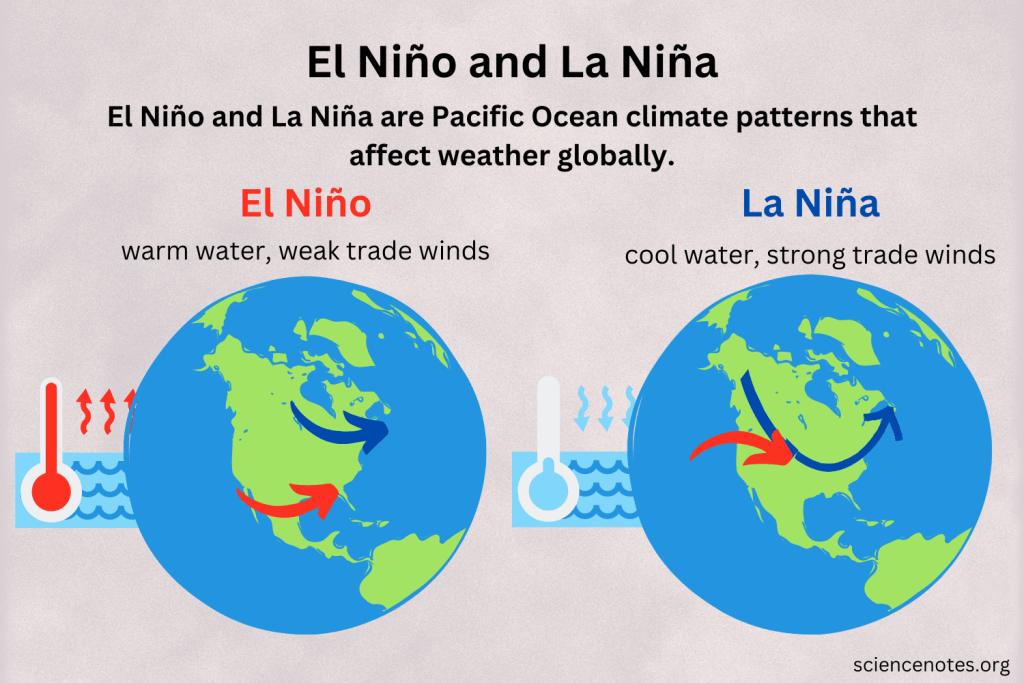
Why should you care?
Because El Niño and La Niña affect:
Agriculture
Crop production and food prices.
Economy
Inflation and GDP growth.
Fisheries
Marine ecosystems and fish populations.
Water Resources
Reservoirs and groundwater.
Disasters
Floods, droughts and cyclones.
Climate
Global temperatures.
In fact, many of the hottest years ever recorded on Earth occurred during El Niño periods.
A Fun Way to Remember
EL NIÑO = Evil for Indian Monsoon
(Not always, but usually.)
Less rain.
Less crops.
More heat.
LA NIÑA = Lots of Rain
More rainfall.
More floods.
Stronger monsoon.
CSEWhy Notes 📌
Normal Conditions
Trade winds blow east → west.
Warm water accumulates near Indonesia.
Cold water rises near Peru.
El Niño
Trade winds weaken.
Warm water shifts eastward.
Indian monsoon weakens.
Higher temperatures and drought risk.
La Niña
Trade winds strengthen.
More warm water accumulates in the western Pacific.
Stronger monsoon.
Flood and cyclone risk increases.
ENSO
ENSO = El Niño Southern Oscillation
It is the periodic warming and cooling of the equatorial Pacific Ocean that influences weather patterns across the world.
My favorite part about this topic?
A patch of water thousands of kilometers away in the Pacific Ocean can influence the price of tomatoes in India.
And if that doesn’t show how interconnected our planet really is,
I don’t know what does.
A very engaging way to learn about it. Splendidly written.
I completed this topic today. It was a fun way of revision! Thank you for sharing