

In March this year, I read a book called “The Thinking Machine”, giving insights into the mind of Jensen Huang, the guy who runs Nvidia
Same Nvidia on whose chips entire AI industry is flourishing! I realized this is a big topic for UPSC and aspirants MUST know about it. Hence, writing this blog

Nvidia Isn’t Just Making Chips Anymore. It Wants To Redefine The Personal Computer.
For years, whenever we talked about computers, the hierarchy was simple.
Intel made the brain.
Microsoft provided the operating system.
And Nvidia? It mostly supplied graphics cards for gamers.
Simple.
But after reading about Nvidia’s latest move, I couldn’t help but think:
What if we’re entering a world where the computer itself gets reinvented?
Not by Apple. Not by Microsoft.
But by a company that started with gaming GPUs.
And honestly, that changes more than people realize.
The AI revolution has changed the rules
Until recently, buying a laptop meant asking:
Which Intel processor?
How much RAM?
SSD or HDD?
But AI has introduced a completely different question:
How fast can your computer think?
Not calculate. Think.
Run AI models. Generate images. Transcribe audio. Code. Edit videos. Summarize PDFs. All locally!
And suddenly, CPUs alone aren’t enough.
Here’s why Nvidia is making this move
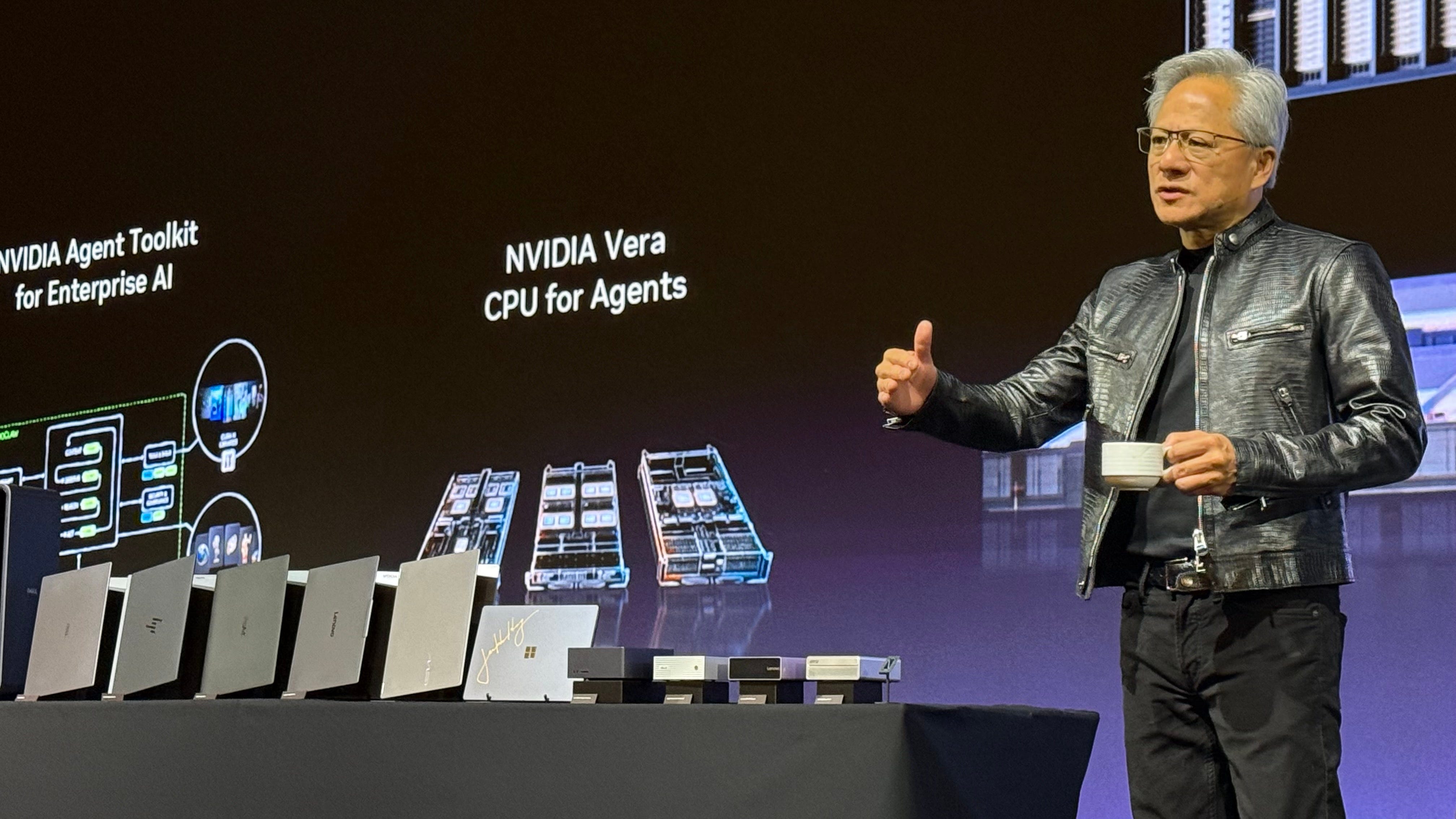
Nvidia recently introduced RTX Spark, a compact AI supercomputer designed for personal computing.
Sounds fancy. But the bigger story isn’t the product.
It’s the philosophy behind it.
Nvidia wants AI to move from giant cloud data centers into your laptop.
Think about that.
Instead of sending every request to servers sitting thousands of kilometers away...
Your own computer could become powerful enough to run AI models itself.
No waiting. No internet dependency. No monthly API costs.
Wait, aren’t CPUs already doing that?
Not really.
Let’s simplify.
Imagine a restaurant.
CPU = The Manager
It coordinates everything.
Takes decisions.
Handles different tasks.
But it’s not built for doing thousands of things simultaneously.
GPU = The Kitchen Team
Hundreds of chefs working together.
Parallel processing.
Massive workloads.
Fast execution.
AI loves this kind of architecture.
That’s why GPUs became the backbone of the AI revolution.
Quick Note ✍️
CPU
General-purpose computing
Sequential processing
Good for diverse tasks
GPU
Parallel processing
Thousands of calculations together
Ideal for AI and machine learning
Nvidia’s real weapon isn’t hardware
And this is where things become fascinating.
Most people think Nvidia won because of better chips.
I disagree.
Its biggest moat is software.
Specifically:
CUDA
Think of CUDA as Apple’s App Store. Or Android’s ecosystem.
Over years, developers built countless AI tools around Nvidia’s platform.
Which means: Even if another company builds similar hardware...
Switching becomes painful.
Because developers have already invested heavily in Nvidia’s ecosystem.
Intel’s dominance is under threat
For nearly three decades, Intel defined personal computing.
“Intel Inside” wasn’t just marketing.
It was an era.
But history teaches us something.
No throne remains permanent.
IBM dominated.
Then faded.
Nokia dominated.
Then faded.
BlackBerry dominated.
Then disappeared.
Now Intel finds itself facing a challenge from multiple directions:
Apple Silicon
AMD
Qualcomm
Nvidia
And perhaps the biggest disruption of all:
AI.
Why this matters beyond gaming
Because AI computing could become as fundamental as electricity.
Every profession is changing.
Doctors.Lawyers. Designers. Students. Creators. Engineers. Everyone!
The next generation of computers may not be optimized for Excel and Chrome.
They may be optimized for:
Running AI agents
Creating videos
Writing code
Generating images
Training personal models
Processing voice and language
The PC itself may become an AI machine.
A thought I keep coming back to
The personal computer changed the world in the 1980s.
The internet changed it again in the 1990s.
Smartphones reshaped it in the 2000s.
AI might redefine personal computing in the 2020s.
And Nvidia seems determined to be at the center of that shift.
Which raises an interesting question:
Will future laptops be judged by RAM and storage?
Or will we ask something completely different?
“How powerful is its AI?”
One question worth thinking about:
Where Does India Fit In The AI Chip Revolution?
While Nvidia is redefining AI computing, I think an equally important question is:
Will India only consume AI, or help build it?
Why Semiconductors Matter
Backbone of AI, EVs, defence, telecom and data centres.
Supply chains are concentrated in East Asia, making them geopolitically vulnerable.
India’s Strategy
India doesn’t need to become another Taiwan overnight. Instead, it can focus on:
Chip Design: India’s biggest strength.
Packaging & Testing: Lower investment, faster scaling.
R&D and Materials Science: Critical for long-term competitiveness.
Trusted Partnerships: US, Japan, EU and South Korea.
My Take
India’s opportunity isn’t to do everything.
It’s to dominate the parts of the semiconductor value chain where its strengths truly lie.
Could you please share the important topics for Prelims 2027?
Someone coming from this industry, I think it was very well written