

India’s defence modernisation is entering a critical phase. The acquisition of Rafale fighter jets has strengthened the Indian Air Force’s combat capability, but the larger story lies in how India is reshaping its fighter jet ecosystem, defence partnerships, and indigenous manufacturing.
For UPSC aspirants, this topic connects national security, defence procurement, technology transfer, and India’s strategic autonomy.
Let’s understand the broader picture.
Why Fighter Jets Matter for India’s Security
Air power is central to modern warfare. Fighter aircraft provide:
Air superiority during conflict
Precision strike capability against enemy targets
Rapid response across borders
Deterrence against adversaries
India faces a two-front security challenge involving China and Pakistan, making air force modernisation essential.
However, the Indian Air Force currently operates fewer squadrons than the sanctioned strength, creating an urgent need to expand and upgrade its fleet.
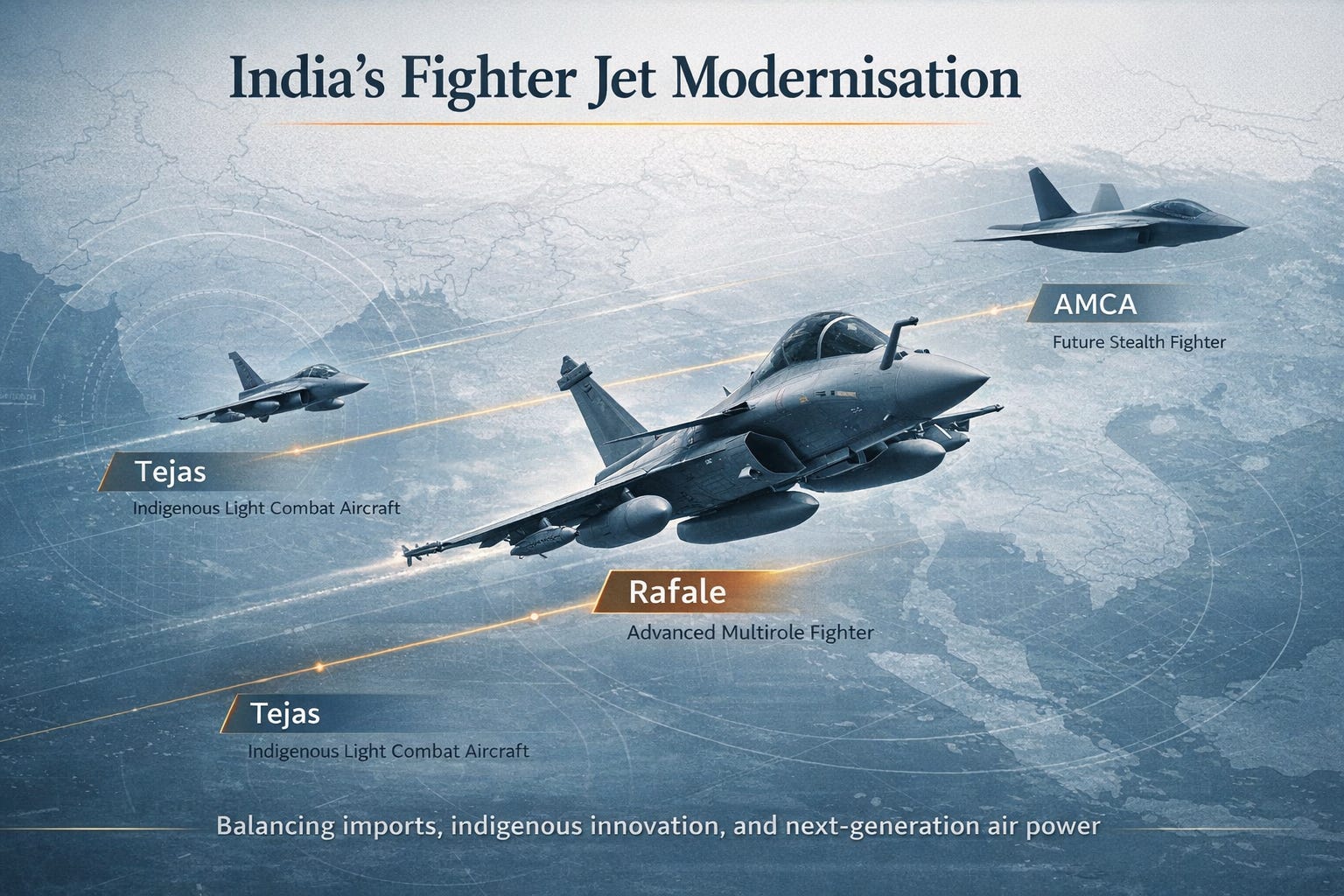
The Rafale Acquisition: Strategic Significance
India signed an agreement with France in 2016 to procure 36 Rafale fighter jets from Dassault Aviation.
The aircraft bring several advantages:
Advanced air-to-air missiles (Meteor)
Precision strike weapons such as SCALP missiles
Superior radar and electronic warfare systems
Capability to carry nuclear weapons
The Rafale is widely considered among the most capable multi-role fighter aircraft in the world.
For India, the Rafale acquisition significantly improved its ability to conduct deep strike operations and maintain air dominance.
Why India Still Needs More Fighter Jets
Despite Rafale’s strengths, the Indian Air Force still faces capability gaps.
Key reasons include:
Declining Squadron Strength
The sanctioned strength of the Indian Air Force is 42 squadrons, but the actual number is significantly lower.
Several MiG-21 aircraft are being phased out, creating a shortfall.
Growing Regional Competition
China is rapidly expanding its air power with aircraft such as:
J-20 stealth fighter
J-16 multi-role fighters
Pakistan continues to induct:
JF-17 Thunder
Chinese-origin aircraft
Maintaining credible deterrence requires continuous fleet modernisation.
The Push for Indigenous Fighter Jets
India is increasingly focusing on domestic defence manufacturing under the Atmanirbhar Bharat initiative.
Key indigenous programmes include:
Tejas Light Combat Aircraft
Developed by HAL and DRDO, the Tejas is India’s first indigenous fighter jet.
Advantages:
Reduced import dependence
Development of domestic aerospace ecosystem
Export potential
The Tejas programme also supports hundreds of Indian defence suppliers and MSMEs.
Future Fighter Projects
India is also working on next-generation aircraft such as:
Advanced Medium Combat Aircraft (AMCA) – a stealth fighter project
Twin Engine Deck Based Fighter (TEDBF) for the Navy
These programmes aim to strengthen India’s long-term technological capability.
Why Technology Transfer Is Critical
One major challenge in defence procurement is technology dependence on foreign suppliers.
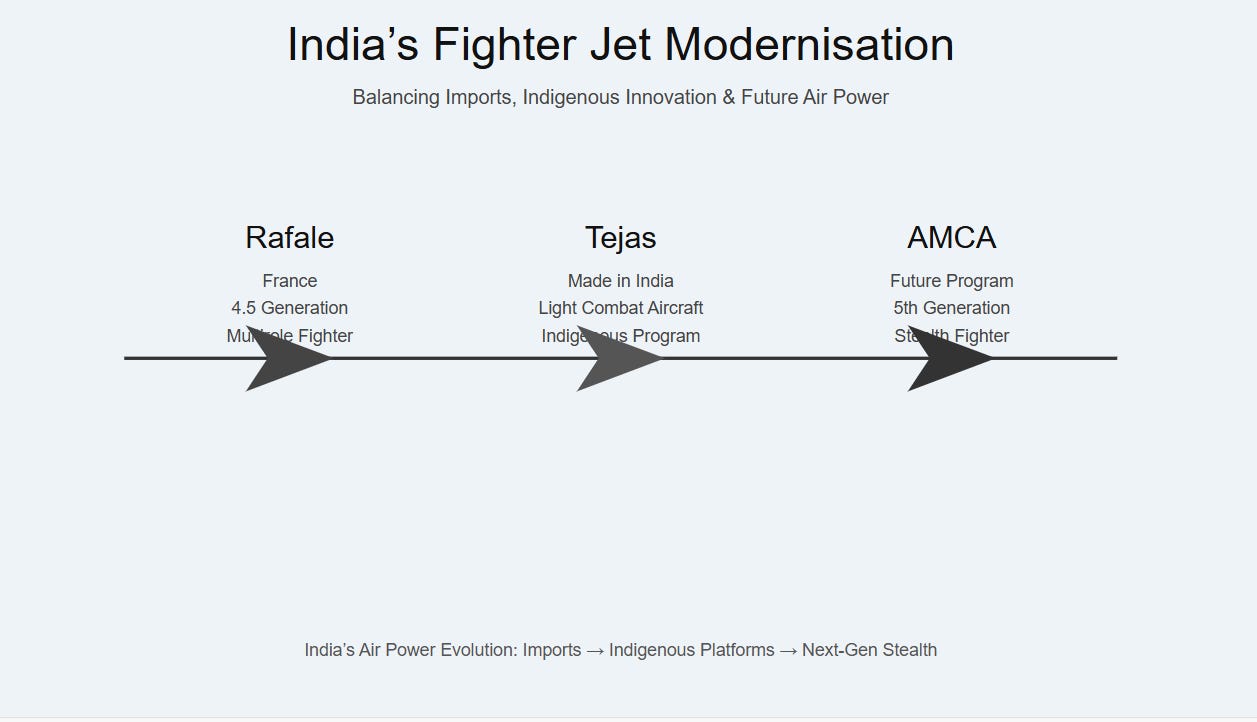
India aims to move beyond simple imports towards:
Joint development
Technology transfer
Domestic production
This approach allows India to develop self-reliance in critical defence technologies, including:
Radar systems
Missile integration
Electronic warfare
Economic Impact of Defence Manufacturing
Defence production is not only about security — it also supports the economy.
A strong aerospace industry can create:
High-skilled engineering jobs
Advanced manufacturing capabilities
Export opportunities
Innovation spillovers
Countries like the United States, France, and Israel have built strong defence industries that also drive technological growth.
India aims to replicate this model.
Strategic Autonomy and Defence Partnerships
India’s fighter jet acquisitions also reflect its multi-alignment foreign policy.
India collaborates with several partners:
France for Rafale jets
Russia for legacy fighter aircraft
United States for defence technologies
Domestic industries for indigenous platforms
This diversified approach helps India avoid overdependence on any single country.
What Lies Ahead
India’s fighter jet strategy will likely involve a hybrid model:
Limited imports of advanced aircraft
Expansion of domestic production
Joint development with foreign partners
Development of next-generation indigenous fighters
If successful, India could eventually emerge as a major aerospace power.
UPSC Relevance
Prelims Practice Question
Consider the following statements about the Rafale fighter aircraft:
It is manufactured by Dassault Aviation of France.
It is a multi-role fighter aircraft capable of both air superiority and ground attack missions.
It is used exclusively by NATO countries.
Which of the statements given above are correct?
A. 1 and 2 only
B. 2 and 3 only
C. 1 only
D. 1, 2 and 3
Answer: A
Mains Practice Question
“India’s fighter jet acquisitions reflect both its security challenges and its aspiration for defence self-reliance.”
Discuss in the context of India’s evolving defence procurement strategy. (250 words)
Conclusion
The Rafale purchase was an important milestone, but it represents only one step in India’s broader effort to modernise its air power.
India’s long-term goal is not just to buy advanced aircraft but to develop a strong domestic aerospace ecosystem capable of designing and producing next-generation fighter jets.
Balancing imports, partnerships, and indigenous innovation will determine the future of India’s air power.