

Before you jump into Iran strikes, here’s me wishing Happy Holi to you and your family
Details of CSEWhy PYQs - Holi sale are below and you can enrol by clicking here

_________________________________________
West Asia is again at the center of global tension. Iranian-linked strikes and counter-responses have escalated tensions across the Middle East, drawing in regional and global powers.
For a UPSC aspirant, this is not just news; it:
International Relations
Energy Security
Maritime Trade
India’s Foreign Policy
Geography
Internal Security
Let’s decode this systematically.
1. What’s Happening? – Geopolitical Context
Iran’s involvement in regional conflicts is not new. It operates through a network of allied non-state actors across West Asia.
The broader fault lines:
Iran vs Israel
Iran vs US presence in Gulf
Iran vs Saudi Arabia (though recently reconciled diplomatically)
Shia-Sunni regional power contest
Proxy warfare through groups in Lebanon, Syria, Iraq, Yemen
The region is sensitive because:
It hosts the Strait of Hormuz
It controls global energy flows
It is home to US military bases
It is deeply fragmented politically
Any strike in this region is never isolated. It has cascading effects.
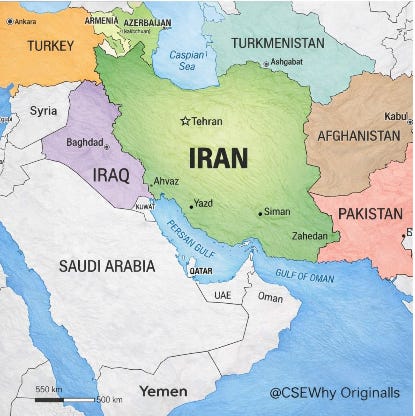
2. India’s Relations: A Delicate Balancing Act
India’s West Asia policy is often called “de-hyphenated diplomacy.”
India–Iran Relations
Civilizational ties
Energy imports (earlier major supplier)
Chabahar Port – India’s gateway to Afghanistan & Central Asia
Connectivity bypassing Pakistan
However:
US sanctions limited oil trade
India reduced crude imports under CAATSA pressure
India–Israel Relations
Strong defense cooperation
Agricultural technology
Counter-terrorism collaboration
India–Saudi & UAE Relations
Energy security
Remittances (8–9 million Indian diaspora in Gulf)
Strategic partnerships
India must balance all sides carefully.
3. Impact on India & Global Trade
A. Energy Security
Over 60% of India’s crude oil imports come from West Asia
Any escalation → oil price spikes
Fiscal deficit pressure
Imported inflation
Even $5–10 per barrel increase affects India’s:
Current account deficit
Rupee stability
Fuel subsidies
B. Strait of Hormuz Factor
Nearly 20% of global oil passes through this narrow chokepoint.
If Iran blocks or disrupts Hormuz:
Global supply shock
Insurance premiums on tankers rise
Shipping rerouting costs increase
C. Indian Diaspora
Millions of Indians in Gulf
Remittance flow risk
Evacuation challenges (like Operation Ganga, Operation Kaveri)
4. Why Iran Is Extremely Difficult to Invade – Geography Angle
Understanding Iran’s physical geography is crucial.
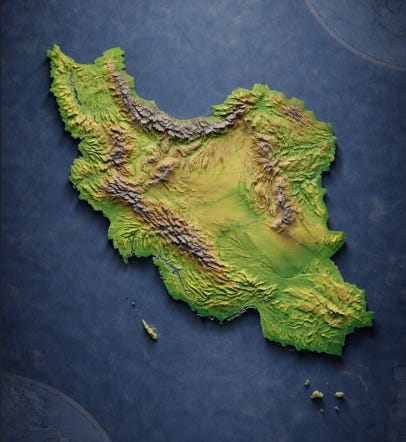
Key Geographical Defenses:
Zagros Mountains (West)
Natural defensive barrier against Iraq.Alborz Mountains (North)
Protects Tehran region.Central Deserts
Dasht-e Kavir
Dasht-e Lut
Harsh, water-scarce, logistically brutal.
Iranian Plateau
Elevated terrain gives strategic depth.Limited Invasion Corridors
Narrow plains near Persian Gulf.
Historically, Iran has rarely been fully subdued for long.
Its geography provides:
Defensive advantage
Strategic depth
Guerrilla warfare potential
Difficulty for large-scale ground invasion
Air strikes are possible. Full occupation is extremely costly.

5. Larger Geopolitical Context
This crisis sits within:
US–Iran rivalry
Israel’s regional security doctrine
China’s expanding influence in Gulf
Russia’s Syria involvement
OPEC+ dynamics
China has recently mediated Saudi–Iran normalization.
Russia relies on Iran in Ukraine war logistics.
The US wants stability but also containment.
West Asia today is a multipolar chessboard.
6. What Should Aspirants Watch Going Forward?
Oil price movement
Strait of Hormuz disruptions
US military response
OPEC decisions
India’s diplomatic statements
Insurance and freight costs
Evacuation advisories
If escalation continues:
Global inflation may rise
Central banks may delay rate cuts
Emerging economies may suffer
7. Other UPSC Angles You Must Not Miss
Internal Security
Proxy warfare model
Non-state actors
Drone warfare evolution
Geography
Chokepoints of world trade
Hormuz vs Bab-el-Mandeb
Economy
Energy basket diversification
Strategic petroleum reserves
IR Theory Angle
Balance of Power
Strategic Autonomy
Multi-alignment
8. Prelims Practice Questions
Q1. Which of the following are correct regarding the Strait of Hormuz?
It connects the Persian Gulf with the Gulf of Oman.
Nearly one-fifth of global petroleum passes through it.
It lies between Iran and Saudi Arabia.
Select the correct answer:
A) 1 and 2 only
B) 2 and 3 only
C) 1 only
D) 1, 2 and 3
Answer: A
Explanation: It lies between Iran and Oman/UAE, not Saudi Arabia.
Q2. Consider the following about Iran’s geography:
The Zagros Mountains run along its western border.
The Dasht-e Lut is one of the hottest places on Earth.
Iran is largely a coastal plain country.
Select the correct answer:
A) 1 and 2 only
B) 2 only
C) 1 and 3 only
D) 1, 2 and 3
Answer: A
9. Mains Practice Question
“Escalation in West Asia has implications far beyond the region, affecting energy security, trade stability and geopolitical alignments. In this context, examine India’s strategic interests and policy options.”
(250 words)
10. Conclusion
Iran strikes are not isolated military events.
They are:
Energy events
Trade events
Diplomatic events
Inflation events
UPSC questions in disguise
A serious aspirant does not just read the headline.
They map it across:
Geography + IR + Economy + Security + Ethics of war. Are you serious enough?
Useful primer for UPSC aspirants. For those preparing answers on India's energy security and the geopolitics of chokepoints, one dimension worth exploring deeper: the Strait of Hormuz didn't become a strategic leverage tool by accident. It was engineered into one over 125 years.
The D'Arcy Concession of 1901, the Anglo-Persian Oil Company, the 1953 Mossadegh coup, the Tanker War of the 1980s — each episode reinforced the same structural dynamic. Understanding this historical arc is essential for GS-II (International Relations) and GS-III (Energy Security) answer framing.
For India specifically, the current crisis reveals something beyond crude oil dependency: condensate flows for petrochemical feedstock and fertilizer precursors transit the same corridor. Iran selectively allowing Indian LPG tankers through while blocking others isn't just a crisis management detail — it's a demonstration of how chokepoint control translates into economic leverage over specific economies.
I wrote a detailed analysis tracing this full 125-year arc from the D'Arcy Concession to today's selective transit enforcement — useful background for essay and GS answer prep: https://nazem.substack.com/p/the-coup-that-never-ended