

India’s maritime policy has never been static. It has evolved quietly, shaped less by declarations and more by geography, trade compulsions, and shifts in global power.
India’s position: straddling the Indian Ocean with a peninsular geography that makes maritime thinking unavoidable. Yet for decades after Independence, the sea remained peripheral to strategic imagination. The focus stayed continental: borders, wars, land forces. Oceans were seen more as trade routes than strategic theatres.
That began to change in phases.
From Trade Routes to Strategic Space
Historically, India’s maritime outlook was commercial rather than military. The Indian Ocean connected India to Africa, West Asia, and Southeast Asia long before modern states emerged. However, colonial disruption and post-colonial inward focus diluted this legacy.
The turning point came with globalisation and energy dependence. As India’s economy opened up, its reliance on sea-borne trade increased sharply. Oil imports, container traffic, and undersea cables turned maritime security from an abstract concern into an economic necessity.
This shift forced India to re-evaluate the sea not just as a transit space, but as a domain requiring governance, surveillance, and power projection.
Institutional and Strategic Maturation
Over the last two decades, India’s maritime policy has matured institutionally. Naval doctrine, maritime security strategies, and coastal security mechanisms have evolved in response to both traditional threats and non-traditional challenges.
Piracy, terrorism, illegal fishing, trafficking, and maritime accidents demanded coordination beyond the Navy. This led to a broader maritime security architecture involving the Coast Guard, port authorities, and state agencies.
At the same time, India began articulating a wider regional vision
safeguarding sea lanes to acting as a net security provider in the Indian Ocean Region.
Indo-Pacific and Power Projection
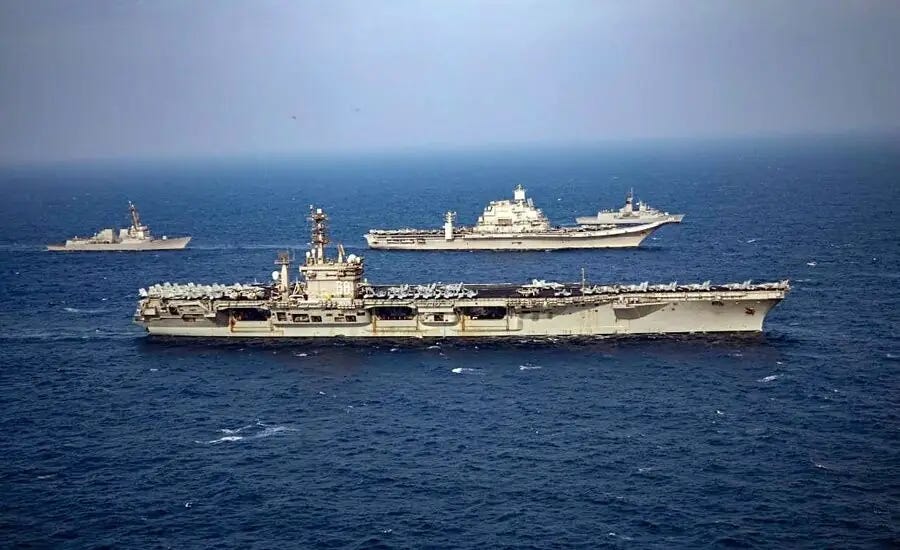
The rise of the Indo-Pacific framework marks another evolution. India’s maritime policy is no longer inward-looking. It now engages with balance-of-power politics, particularly in response to China’s expanding naval footprint.
However, India’s approach remains cautious. Unlike overt militarisation, it emphasises partnerships, capacity building, and freedom of navigation that goes onto blending realism with restraint.
What Lies Ahead
India’s maritime future will be shaped by technology, climate risks, and great-power competition. Underwater domain awareness, blue economy governance, and resilient port infrastructure will define the next phase.
The challenge is not intent, but execution. Maritime policy demands coordination across ministries, long-term investment, and political attention which are areas where India has historically struggled.
For UPSC aspirants, the key insight is simple:
India’s maritime policy reflects how geography slowly forces strategic maturity. The sea was never optional. India is only beginning to act like it.