

India counts its people and houses every 10 years (as per a Parliamentary mandate)
Other than this, we do see birds and animals census but this post is all about the GRAND Indian Census and take you through 2027 Census journey.
Census
Process of collecting, compiling, analyzing & disseminating demographic economic & social data (at a specific time) of all persons in a country.

1. History
• Mentioned in: Rigveda (800-600 BC), Arthashastra (300 BC), & Ain-i-Akbari (16th century)
• 1st non-synchronous Census (limited reach): 1872 u/ Gov. Gen. Lord Mayo
• 1st synchronous Census (entire Bengal covered): 1881 u/ Lord Ripon (Census Commissioner: WC Plowden)
2. Responsible Body
• ad-hoc basis till 1951
• 1951 onwards: Office of the Registrar General and Census
3. Legal Backing
• Union list subject u/A 246
• u/ Census Act, 1948
4. Census pointers:
• First: 1872, first completed: 1881, first caste census: 1931
• Conducted by: Office of the Registrar General & Census Commissioner u/ MHA
• Legal basis u/ Census Act 1948
Next census: conclusion expected by 2027, last census in 2011
5. Significance
• Largest single source of population’s statistical information
• Use case: Good governance
• Constituency demarcation in LS/VS
Socio-Economic and Caste Census (SECC)
• 1st ever in 2011
1. Components
• Economic status (to define a poor/deprived person)
• Specific caste (to evaluate castes that are economically worse or better of)
2. Constitutional Backing
• Article 340: Mandates appointment of commission to investigate conditions of socially/educationally backward classes
Okay CSEWhy, but what’s the diff b/w Census & SECC?
• SECC identifies beneficiaries of state support while Census gives national population data
• SECC data open for govt. department use but exact Census data is confidential
3. Significance
• Better inequality mapping
• Quantifiable data to support existing reservation levels
4. Key Findings of SECC 2011
• Total Households: 24.49 crore
- Rural: 17.97 crore
- SC/ST Households: 3.87 crore (21.56%)
• Households with no literate adult (age >25): 23.5%
5. Constitutional Articles & Acts
a) Article 246: Outlines subject matter of laws made by Parliament & State legislature.
Divides the powers in 3 lists: Union, State & Concurrent (Census u/ Union)
b) Article 170: “The population data to be used for drawing boundaries of constituencies will be as per 2001 census until 1st census post 2026 is published”
So, why 2011 census used in JnK: JnK Reorg. Act ‘19 mentioned 2011 census data for delimitation
c) 84th AA 2002: Delimitation census freeze
Key features:
• Amended Articles of Delimitation (81/82) & SC/ST reservation (330/332)
• 1971 census figures extended to parliamentary seats distribution till 2026
6. Trivia
• 5th census (1921)
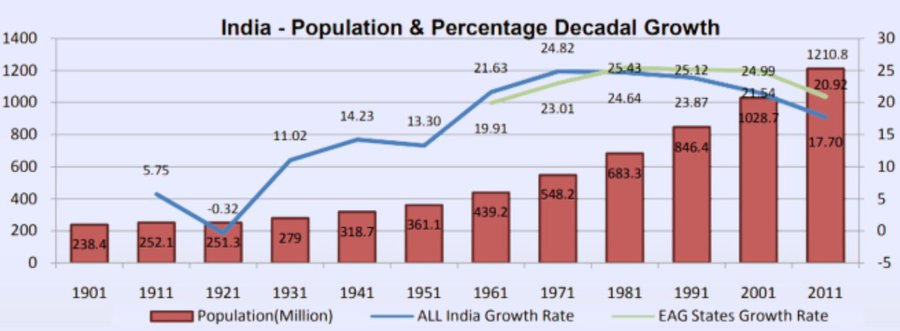
Only census to see decline (0.31%) and referred to “THE GREAT DIVIDE”
• 13th Census (1991)
Concept of literacy changed to children of 7+ age (earlier 4+)
• 15th Census (2011)
Notable fall in case of Empowered Action Group States (EAGS) noticed first time